Sep 3, 2013

Review: Gunpoint (PC)

I straight up bought Gunpoint on the strength of its free demo, and ultimately ended up feeling about it more or less the same way I felt about Anodyne: it was just about enough fun for the money, though I wouldn't have minded if the base experience had had a little more meat on its bones.

Gunpoint sort of reminded me of Stealth Bastard, only more fun. Whereas Stealth Bastard made me feel more or less like I was playing Super Mario Bros. with shadows and a stealth meter, Gunpoint actually made me feel like I was a superspy with super abilities, dodging (mostly) bumbling idiots.
Pictured: Stealth Bastard
The fun of the game comes from finding new and different (and, optionally, increasing violent and hilarious) ways to avoid and/or destroy security guards. Normally, I don't link to trailers because it seems extra-lazy, but in this case I think this video does a great job of showing what the gameplay's all about:
The other great thing about the game is its humor. It was written and in large part created by Tom Francis, whose work in game journalism I've always enjoyed, and the game itself shows off the self-awareness that comes from someone who picks on other people's games for a living. Fourth-wall-breaking abounds, tooltips are hilarious, and the branching-tree dialogues that follow the completion of each mission provide choices that are, for once, not boring, stilted, and canned-seeming, but are instead clever, amusing, and surprising all in turn.

The game lasted me about 4-5 hours, all told (I think), and I came away feeling like I got my money's worth. It was one of those games that I thoroughly enjoyed but in retrospect think of as being repetitive and as much as I'm wired to always want more content, I think if Gunpoint had continued on in the same vein for a few more hours, I might have quit out of boredom before I reached the end. Basically, it's just as long as it should be.

And I guess, oddly enough, that's my complaint. For such a "lite"-type game, the art style is attractive, the music fits, the dialogue is interesting and the story is actually pretty multilayered and engaging. The aesthetic is pretty much perfectly tweaked. The controls are tight, and the game mechanics are clever, if a bit bare. It just sort of seems like Francis could have done even more with the game. It's such a damn good game, in a design sense, that it's almost frustrating to not see more done with what's there. When the game starts, it has a feel to it that's similar to World of Goo or Blocks That Matter, or one of those other games that slowly, excellently teach you skill after skill until you've mastered, but then it turns out that there's really only 2 or 3 skills to master and the rest of the game just asks you to use those skills over and over again, and that's it.

That probably makes it sound like I didn't like the game. But I did, very much. I'm just surprised whenever I play a game like this that's absolutely satisfying as-is, but feels like the groundwork is already laid for something even better. Then that something better never comes, and it's weird to be happy with what you've got while also wishing it could have been more.

Anyway, that's a super-vague sort of review, but I'm hungry and I'm going to go eat now.

Aug 27, 2013

Review: Anodyne (PC)

I'm writing all of these reviews in a row while flying from Cleveland to San Francisco. So, if my word choice is getting stupider as we go, that's my excuse.

Anyway, next up on the review treadmill is Anodyne, a game I actually finished and generally liked. I have no ulterior motives when it comes to this review. I just want to talk about something that was nice and that I liked.
I liked this.
I played a demo of Anodyne and it won me over. I paid $10 for it on Steam. I don't know that it was worth that much, but I was at home alone in my parents house at night and was bored because I sort of hate TV. If you see this game on sale for under $5, I'd recommend it. If you are not strapped for entertainment sources in the middle of the night and you pay $10 for it, you might come away feeling a little bit ripped off.

How's that for topical cohesion in a paragraph?!
THIS IS HOW THE WORLD LASERS WORK, FELLOW LEMON GIANTS!!! AOUVAE;JAFDKFJKADLJAE?
Anodyne is pretty clearly based off of the early NES and SNES Zelda games in terms of gameplay. Even the status bar thing at the top of the screen is basically lifted from the original Zelda. Unlike the other recent Zelda-homage The Binding Of Isaac, though, there's no roguelike action welded on here. Instead, it's just a straight-up action-adventure from out of the old days. A well-designed overworld and dungeons, subtle ambient-ish soundtrack, solid “feeling” controls, and great art direction (within a classic Game Boy Color-esque palette) all help make it a fun six-hours-or-so playthrough.

The premise of the game, as near as I can tell, is that it takes place inside the main character's subconscious. The main gripe I've seen online about Anodyne is that it doesn't actually have a “story,” but I'd disagree with that. Sure, it doesn't have a lot of obviously meaningful dialoge. There's no MacGuffin, per se, and we don't learn directly about the main character's backstory. However, if you're willing to read a bit between the lines Anodyne says a lot by saying very little, using colors, visual cues, and musical themes to communicate a lot of what would usually just be communicated via a text box and clunky exposition. I liked this. I can see how some people wouldn't, but to me, Anodyne is one of the more successfully “literary” games I've played.
THIS IS JUST A MOVIE ABOUT PARTIES AND HOW AWESOME THEY ARE
In the same way that someone outside of a literature class might read Ulysses for five pages and conclude that it's utter, worthless madness while someone in such a class might pore over details until patterns of meaning start to emerge, paying close attention (performing a “close reading”) of Anodyne is rewarding. But if that sounds stupid to you, it's probably going to be stupid and you won't like it. But that's not because you're stupid. Anodyne isn't especially “deep” in the way that guy in your English class with the patchwork pants and bandanna was, but it communicates in meaning in ways that we generally don't expect games to, and that makes it interesting to me. Morever, it does this well, not just as a gimmick, and that makes it satisfying to me as a gameplay experience.

If you're the kind of player who doesn't need much out of a five-hour game except a little low-difficulty puzzling and dungeon-crawling as well as a little hack-and-slash, you could also probably just ignore all the high-falutin' shit and enjoy the game purely as a game. But on this level there are a million other games like Anodyne already out there, so why choose this one?

What elevates this already-solid game is the way it presents its themes and conflicts. If you feel like searching for meaning as well as for keys and weapon upgrades in a low-fi Game Boy Color world, this is a game that's going to feel like it was made just for you.


Semi-gripe: it's a bit short for $10, but honestly by the time the game was over I felt sort of done with it, in an I-liked-this-but-now-it's-starting-to-get-repetitive way. I didn't really expect it to show me anything else interesting, and it didn't seem to want to. I did figure out how to do the tile-switching post-game thingie, but wasn't really compelled to revisit the game just for the sake of that.

Review: Gratuitous Space Battles (PC)

Mymain complaint with Teleglitch (other than it being bastard-hard and just outright hating me) was that it failed to really give me any feedback, and I suppose I could say the same thing about Gratuitous Space Battles. GSB is another well-reviewed game that went on to spawn a number of DLC packs and, later, a tank-filled sequel. I got the original game in some super-cheap bundle, was really excited about it, really, really tried to like it for about five hours of play, and then completely gave up.

Apparently, it's a really deep strategy game worthy of lots of brow-beetling and micromanagement (which normally I very much enjoy); however, I had a real hard time understanding how I was expected to be involved in playing the game at all since it refused to ever tell me anything.
Just like women! Right, guys? Am I right or what? Huh? HUH?! Shopping.
The original GSM is, essentially, just a series of battles you choose to fight in whatever order from a menu. The weird thing (to me, at least) about GSB is that you spend lots and lots of time preparing for each of these battles designing ships, customizing preexisting ships, orienting ships and placing them on a grid, and then you click “GO” and watch the battle fight itself. I don't necessarily expect a lot of verisimilitude in my gaming (Minecraft is one of my favorite games), but this is not how battles work. In fact, the entire understanding of modern warfare is based on hierarchies, chain of command, and dissemination of orders that change on a minute-to-minute or second-to-second basis. Strike one against GSM is that it creates a hypothetical battlefield in which each soldier is given his/her own equipment and set of orders and turned loose with no way to recall that soldier or to organize sets of soldiers into specific formations.

For example, unless I'm a complete idiot, there's no way to make your tiny, fragile fighters hold off from drawing a big enemy cruiser's fire (for the purposes of having your cruiser sidle up alongside it unmolested) until your cruiser gets into an advantageous position. Instead, what happens every time is that your fighters (faster fliers, by nature) jet out ahead and get massacred before your big ships can even cover the distance to the enemy fleet. By putting the fighters behind the rest of my formation, I increased the amount of distance they had to cover and thus could approximate the effect I wanted, but shit. Seriously. Back when all we had were horses and big pieces of metal to hit each other with, armies didn't have to put the horses in the back of the formation to keep them from running in a straight line right into the enemy lines ahead of the rest of the army. Because we had mouths and ears and could tell soldiers to wait until it was time to attack. That the game simulates this kind of illogically weird battlefield makes it hard to learn and made me not terribly inclined to bother with it after a few hours.

The killer, though, was the lack of feedback during and between battles. The ship-building and fleet-arranging screens let you customize the pre-battle to a ridiculous level of detail (and this probably really appeals to a certain type of gamer). However, once you get into the battle, there's just a lot of flashy explosions and status bars that correspond to each ship's hull integrity and really no way to tell if the fighter-seeking missiles you bought are working or if that second beam-shield you installed on your cruiser is making it die less fast. It's absolutely the feeling of turning in a detailed, nuanced essay at the end of a 15-week college course just to get it returned with a “B+” marked on the front page and nothing else. When I won, I didn't know why I won. When I lost, I didn't know why I lost. I play a lot of video games. It shouldn't be this hard for me to understand how the game communicates feedback to me. Therefore, I have to conclude the feedback just isn't being communicated.
And that sucks, because building the fleets is pretty fun, and I imagine that over the course of the campaign, as one creates and saves more and more custom layouts, that it provides a pretty good feeling of actually creating something clever. Too bad the game really doesn't have any way of rewarding you for that cleverness.

Review: Teleglitch (PC game)

So, as I might have mentioned before at least a thousand times, I spent much of my leisure time over the last 16 months or so playing through the Infinity Engine RPGs, including playing Planescape: Torment for the first time. I enjoyed P:T so much that I went on to give Fallout a try, and that compelled me to play Fallout 2. Somewhere early on in that game, though, I finally got sick of isometric RPG madness and turned to my games backlog (which had slowly been building up, understandably, during my year-and-a-half hiatus). So over the last two weeks since my return from Phish Driving, I've put some time into a bunch of critically-acclaimed indie games that I thought might be worth my $5 here and $10 there. Some were and some weren't. This...is their story.

I wrote recently (well, fairly recently) to complain about the tendency of “RPG-lite” mechanics to creep into nearly each and every genre and game coming out of AAA development houses nowadays. I prefaced that post by establishing that I'm definitely not against the practice of genre-melding in general, but that if you play enough games over enough time, it becomes much easier to spot a fad as compared to a legitimately creative remix of conventions. I went after the new Tomb Raider in that post, for no real reason other than that I'd just read about it that day, and was confused over what, if anything, the “RPG” portion of the game added to the overall experience other than functioning as an acknowledgment of the apparent requirement that all new AAA games now include a Distributing Skill Points That Don't Effect The Actual Gameplay In Any Meaningful Way At Preset Intervals Throughout The Game minigame.
This is actually the New Game screen from the latest Pac-Man sequel.
I suck at foreshadowing, and this is my slow, plodding way of telling you that I'm going to discuss something similar in this post.

This time, though, I'm going to lay off on slagging AAA games (for once) and focus on a topic nearer and dearer to my heart: all those adorably quirky low(er)-budget-type games. See, now that I've finally wrapped up my Infinity Engine bender, I've been putting in some time toward the gargantuan task of whittling down the To Play queue that I built up over the last 16 months. So far, I've played through a few of the better-reviewed and cheaper-priced “indie”* games that have come out lately and have been very happy with a few of them but surprisingly disappointed with the others.
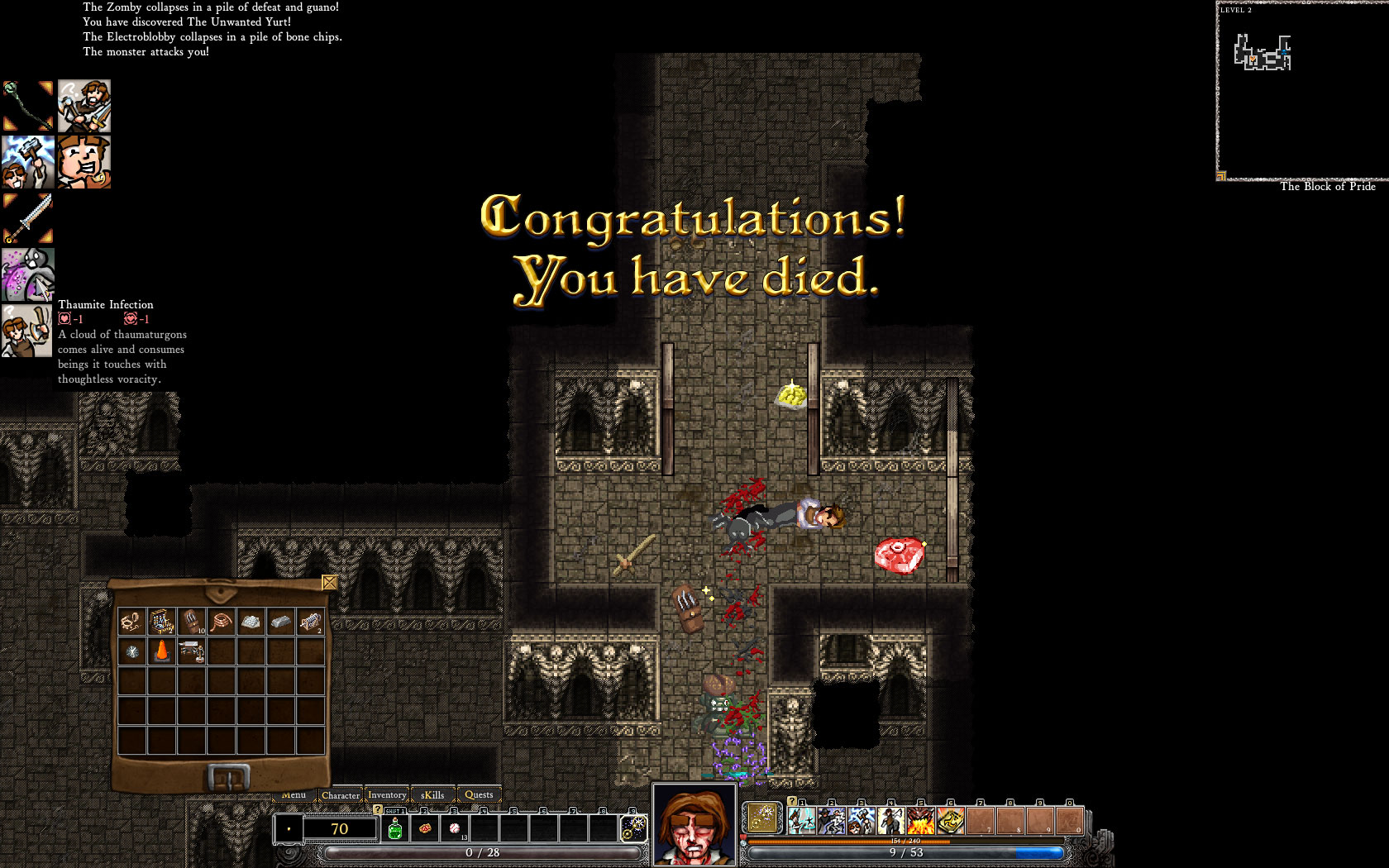
Yes, yes, I see you. You're very charming. However, you're not fun to play AT ALL.
The ones that I haven't enjoyed all that much generally share two qualities: a) RPS loved them, and b) they have “roguelike elements.” a) is weird because generally my tastes and those of the writers at RPS are pretty much entirely compatible. As in, like, I should probably be married to and living with their collective hivemind instead of dating my girlfriend. But whatever, tastes is tastes.

I want to talk about b). Because while I don't think the cases are entirely equivalent, I think there's a lot of similarities between AAA developers' love for “RPG elements” and “indie” developers' love for “roguelike elements.” And, because this post isn't structurally complicated enough as it is, I'm going to discuss this while trying to review Teleglitch. So hold on to your rhetorical GPS and gods willing, we'll all wash up on shore alive together at the end.

I try to write as much about games I dislike as ones I like. Writing about a game you like is easy: you talk about how awesome it is and on top of that, you have the motivation of trying to win over other fans of the game and expose them positive gameplay experiences like the ones you presumably had. Writing about games you dislike can also be easy: you can just talk shit about how terrible they are and wallow in the internet stupidity of any flamewars that follow. Generally when I write about a game I don't like, though, it's because lots of other people whose opinions on games I respect really, really like said game and when I find that I still hate playing it after giving it five hours of my life, I begin to suspect there's something wrong with me. Sort of like that moment in a grad seminar when everyone else is finding deep, intellectual meaning within a text and empathy with all the scholars who have heaped effusive praise on it and you're just sitting there having not even read it all the way through because last night it struck you as so muddled, pretentious, and purposely inaccessible that you just threw it across the room. Clearly, everyone else is right and you're just stupid, right? Well, maybe.

Teleglitch has been a sort of indie** darling lately, one of those games that reputable games writers and fans can both agree is fantastic. I disagree with all of these people because I've put a good double-fistful of hours into the demo*** and I don't just find it boring but actively dislike it. If I tell you why, maybe we can both find a little slice of peace together. Because I know this matters to you.

Anyway, Teleglitch is one of those games that sounds awesome on its face, and, honestly, I almost just bought it based on a brief description and RPS's enthusiasm. Fortunately, the demo stopped me. Teleglitch is a low-fi atmospheric shooter. Mechanically, it's of the Hotline Miami variety: top-down perspective, steer with the keys, aim and fire with the mouse. But to compare it directly to H:M would be disingenuous; they're very different games, aiming for very different effects. Teleglitch reminds me maybe most directly of Doom and Doom 2. But not brutal-chaingun-slaughter-party Doom. Doom played on Ultraviolent skill level, where you always ended up having to punch and chainsaw your way through three levels in a row because there just weren't enough bullets. Where you had to kill two Cyberdemons with a pistol because that's all you had left. Where you spent five levels below 20% health constantly, jumping at the sound of each and every enemy.
Like this, only with just bare fists.
This approaches a description of what Teleglitch is like. But, honestly, it's even more like Doom played on Nightmare! skill level, where all of the abovementioned qualities apply, but your experience is underscored by the fact that, unlike Ultraviolent, this skill level isn't designed to let you win. The game is less about reaching the end than just trying to see how far you can get before you get killed. And that's where it (both Nightmare! Doom and Teleglitch) lose me.
"Would you just stop killing me [SPLAT!]  I just want to talk [BLAST!] I think this might be a compelling experience [KILLIFY] if you would just [MURDER?] stop [BEASTS!]  oh, forget it."
In addition to functioning pretty satisfyingly as a top-down, hyper-difficult Doom, Teleglitch throws in procedurally-generated levels (surprise!) and random loot drops that result in lots of different weapons and other tools that help you survive for another few minutes. The effect is a game that is incredibly atmospheric, and that (at times, at least) hits that sweet spot the best roguelike games camp out on: the joy of finding and deciding how to best deploy random loot to increase your chances of survival.

Unfortunately, you will not survive, and so eventually this loot discovery seems pointless. There's nothing that's actually going to keep you alive for more than another minute or so in that chest, so how cool is it to be able to build a panzerfaust out of some explosives and a cardboard tube, really?

And here's where I zig-zag my way back to my post on Tomb Raider: Teleglitch feels like a really good game that was made into a roguelike because everything is just supposed to be a roguelike now. As far as I'm concerned, the procedurally-generated levels really add nothing to the game (the environments are all so similar that even if I was going through the exact same level each time, I probably wouldn't be able to tell one room from another). The extreme difficulty is just not fun because I never feel like I'm accomplishing anything, and any progress I make from my previous run-throughs ultimately ends up just feeling like luck. Teleglitch doesn't feel like a game to me. There's nothing to learn, except that you will die, always. And I guess this is fun for a lot of people but not for me.
This seems especially unnecessary.
I want to learn from games. I love a game that places you in a compelling gameworld and convincingly makes you part of a larger, fictional drama, but really, when it comes down to it, all I really need out of a gameplay experience is that feeling of slowly but satisfyingly mastering the gameworld's rule system and progressing as a result. World of Goo absolutely excels at creating this feeling. Another game I played recently, Blocks That Matter, does too. Solutions aren't spoon-fed to you by any means in these games, but they are games that make it clear that solutions are there. If you're not seeing them, it's on you. In Teleglitch, it feels like there are no solutions; everything just feels futile.

This seems to be the case in many recent games where roguelike elements are included “just because.” And I hate to see this because despite the fact that I haven't been a roguelike fan for years and years like I'm sure you have been and I've never played Rogue or Dwarf Fortress, I really like a lot of the elements of the genre. I've had an absolute blast playing games like Desktop Dungeons, Red Rogue, and Mysterious Castle. But each of those games, despite their difficulty and (in some cases) neverendingness, always make me feel like I'm getting better, and that if I fail quickly it's because of some failure on my part of apply what I've already learned. When I die in Teleglitch, it just feels like the game got pissed at me for living for 4 entire minutes and smacked me down before I got too uppity.
Without their roguelike elements, Desktop Dungeons would be a bland number-crunching puzzle game and Red Rogue would be an artistically interesting but otherwise standard platformer. Without its roguelike elements, Teleglitch would be a really engaging, atmospheric top-down shooter that I would probably still be playing.

What gives?

* I still really don't like this label being broadly applied, but that's a topic for another day (or previous posts).

** This game really is just made by one guy (I believe) and so I'm laying off the quotes.


*** I've been assured by the internet that the demo is just the beginning of the full game, so it's not like I'm missing out on hugely varied content that would change my opinion were I to play the full version.

Aug 19, 2013

Here I Go Again On My Own, Part One

So this post is going to function (unintentionally) as a counterpoint to my previous post. I failed to realize, when I wrote all of that shit about how I can't function by myself in polite society, that I would be travelling pretty much entirely on my own for part of July and early August and that my survival would hinge on my ability to successfully interface with complete strangers on a regular basis without any comforting intermediary whatsoever.

I've survived these experiences (so far), and am re-heartened by my continued ability to drive really long distances alone and sleep on the ground and eat plain-as-fuck camp food for a week at a time without losing my mind.* Of course, for much of my recent trip I was in the middle of writhing crowds of thousands of people who were all high on all kinds of drugs as our senses were peppered by laser light shows and improvised music that was funky, jazzy, spacey, and downright spooky by turns, so it's actually entirely plausible that I was completely insane the entire time and just thought I was sane compared to my surroundings.

I was at Phish, is what I'm trying to say. I went to the Phish. I drove down the west coast following a band from city to city with a bunch of hippies. Except nowadays, they aren't hippies anymore. They're all forty years old and travel from show to show in airplanes and rental cars and stay in hotels. They still all party like the asshole frat boys they used to be (or wish that they used to be, or whatever), but people who legitimately drive from show to show, camping on the ground and scraping by, seem few and far between. I understand why, though: it's pretty hard on a guy. But still, I was surprised to find that the people who follow Phish around the country (nowadays, at least) are not My People as I thought that they might be. No big deal, though: the people (in general, not in total) might have sucked, but the band was amazing, and far better than I had even hoped they might be. I saw eight shows, and if there had been more after that, and if I had more money and more free time (and no desire to spend the rest of my summer break climbing mountains, I guess), I probably would have kept going. But, the wonders of the Phish is a topic for another day.

Today, I want to talk about Mother Roads.

Mother Roads is not exactly a cruel mistress, but she can be an icy one. Metaphorically, in the sense that traveling the highway for a protracted amount of time can be a lonely and not-obviously-rewarded endeavor, and also literally, in the sense that sometimes the road gets icy and it's dangerous to drive on. But, since this road trip took place in July and August, I'm talking more metaphorically and less literally.

I spent a lot of time driving back and forth between Ohio and Washington when I was a young lad (a few long years back, in my mid- to late-twenties) mostly because I was hella broke and with my super-fuel-efficient car it was way cheaper than flying. But I also did it because there was something comforting and rewarding about the obviously-masochistic-on-its-face exercise of driving thousands of miles at a time, by yourself, across a country that is so damn physically big and culturally varied that people on one end often cannot understand what people on the other end are saying even though they are nominally speaking the same language.

Now, the last time I did a drive of this magnitude on my own was almost five years ago. I've gone on a few long drives since then, but they've all been with groups of friends and/or with Lindsey. I had an opportunity to drive from Pullman to San Francisco and back last summer (about twelve or so hours each way, over the course of a few days) and ultimately ended up passing it up and staying home, partially because the idea of driving that far alone just seemed hard and not worth it unless it was for some absolutely necessary reason (like, say, getting back to Pullman in time for work starting in the fall so I could keep my job).

In this case, I was driving much further, even, than I would have last summer. To see the concerts I wanted to see, I had to drive from Klamath Falls to Lake Tahoe (6 hours), then from there to San Francisco (4 hours), then from San Francisco to Los Angeles (6 hours), and finally back to Klamath Falls (10 hours). I did this over the course of a week, so there was never any extremely concentrated doses of driving, but there was a lot of sleeping on the ground in cheap, crappy campgrounds (much more nerve-wracking and uncomfortable than sleeping in the wilderness), a lot of eating cheap, crappy food, and a lot of time spent alone, even if only about half of it was spent in a car.

As I wrote before, way back in my original road-tripping days, I find this kind of trip really satisfying in a sort of masochistic way. It's difficult to sit in a car for hours at a time for days on end, alone, with nothing but landscape for company, and yet, once you've been at it for awhile, you're forced into a sort of meditative state. When there's nothing to do but think, even the things you normally don't want to think about or worry about become fair game. And that's good. Having time to myself like this from time to time not only makes me think about things I would normally suppress, it also makes me appreciate what I normally have once I get back home. Basically, it's always ultimately a great experience, but it's hard to get out the door. It reminds me a bit of running: I've never been on a run I wasn't glad I'd done by the time I finished, but I've also never started a run while thinking "Fuck yeah, running! This is gonna be awesome!" Generally, I can count on having had a positive experience by the end, so it's easier to break through the initial hesitation.

In this particular case, the initial hesitation lasted well into my stay at Lake Tahoe. The drive from K-Falls to Tahoe reprised the first half of a drive Lindsey and I took in 2011, from Tahoe up to Pullman, and it's not one of my favorite drives. It's almost six straight hours of flat, dry, near-featureless desert, punctuated occasionally by dried-up salt beds that used to be lakes and dead towns with nobody living in them anymore. I can find pretty much any landscape beautiful, including Hell's Canyon and the channeled scablands of eastern Washington, but this drive just kills me. I was only an hour or so in when I already started doubting my resolve to spend a week driving through (mostly) empty country just so I could see a bunch of friggin' concerts. After listening to a live Phish recording and making my way nearly to Nevada, though, I started to cheer up a bit. I really like Tahoe in general, and the campground we stayed there in 2011 was excellent, so I had high hopes for this stay.

I needn't have worried: the campground I'd reserved a spot in this time was even better than last time's. Despite being a CA State Park campground, there was a lot of space between each site and that space was filled with huge coniferous trees, so even though the entire campground was fully booked, it didn't seem crowded at all, and I spent a good amount of time over the two days I was there comfortably sitting in the shade of a tree, reading from my Kindle and/or taking a nap without feeling at all like I was in the middle of a campground full of people.

I think Tahoe was a good place to start the trip, because it was the only destination that I'd ever been to before. A lot of what sucks the fun out of trips like this for me are things like trying to find the campground, trying to figure out where to park near the concert venue, etc. and I'd already done that once in Tahoe, so I knew (in general, at least) how things worked.

Things went downhill a bit after Tahoe in terms of my ability to walk the path of Mother Roads alone, but that's a story for a follow-up blog post...

* Also, my ancient godddamn car's ability to continue to not just fall apart like all other cars would have done 40,000 miles ago is commendable and certainly helped me bear my burden.