Oct 29, 2013

Review: 140 (PC)

Holy wow, 140 is pretty neat, you guys.

This'll be a short review because it's such a short game. But it's a very good game. It is, to paraphrase another review that I read, a rare example of gaming minimalism done right.

The premise is made pretty clear in the surprisingly functional game trailer:
It's a platformer with an abstract, shape-y aesthetic. Already you're groaning. Stop groaning.

What makes it interesting is that all of the platforming moves and tricks are dictated by the beat of the background music (reflected cleverly in the thumping equalizer that makes up the game's background): platforms move, walls shift, and solutions emerge and disappear in time with the music, and as you make your way through the level, more elements are added to the background track to reflect the increasing complexity of the gameplay.

There are three levels in the game (and clever transitions from one to the next), and each level culminates in a "boss fight" of sorts, that changes the gameplay a bit (for example, one is sort of a top-down bullet-hell-style shooting game) but doesn't deviate from the game's rhythm-based challenges. These boss battles were jarring at first for the sudden fact that I wasn't playing a platformer anymore, but the new play modes are really just more riddles based on the rhythm of the background music. Once you figure out the beat, these "battles" are a lot easier.

If I have one gripe (and I always do), it's that at $4.99 the game seemed a little overpriced. I finished it in under and hour, it was awesome, and I went back and played it a few more times just for fun. It ends at right about the time it seems like it should, but yet the concept is really great and executed so flawlessly you can't sort of help but want more variations on the jumping puzzles, more clever bosses, more music. The fact that you don't get more doesn't leave a sour taste in my mouth as much as it just makes me hope that there's a sequel or something someday, but if you're pinching pennies, for the length of gameplay you get, you might want to wait for a sale. That said, if you're at all interested in music and/or platformer games, wait a month or so for the sale, and then buy it whether there's a sale or not.

Oct 23, 2013

Yoga Ball Plinko

Since I mentioned this yesterday, I wanted to follow up with a video to prove that this was actually a thing I did, and not just words I mashed together because internet.


Oct 22, 2013

HELLOOOOOOOOOOOOOOOOOOOOOOOOOOOOOOOOOOOOOOOOOOO?

Is there anybody in here?

It's so quiet since I put Robocop, Captain America, Hercules, and Gipsy Danger outside to guard the door.

I guess I can finally post this, at least:


(Not So) Defiantly (Maybe): Profile Fatigue and Why I'm Hiding My Blog From You Now

Note: This was cross-posted on Recomposing the Pines today.

So, tonight marks sort of a big moment for me and my relationship with the internet.

I started my first blog in December of 2004, and ever since then, first on Livejournal, then Blogger, then Tumblr, and then Blogger again, I've written whatever came to mind about whatever came to mind, and left it all available for anyone to read, both in the interest of generating discussion and as an exercise in self-expression. Before blogs, before social networking was a thing, I wrote pretty consistently (both fiction and just general thoughts) on my computer from 1995 or so up until 2004, and though there wasn't as ready a mechanism for making those writings widely available at the time (thank god!), I was willing to share them with whoever was interested.

As of tonight, I'm changing my primary blog over to private, so the entries can only be read by people who I've personally okay'd. Here's why.

One of my absolute favorite times to be doing anything on the internet was when I was blogging c. 2006-2008. Facebook wasn't a huge thing yet (at least not in my social circles), I had a MySpace, but it was a secondary form of communication, for the most part, to email, and blogging was fun. I've never had a large readership on any of my blogs, but I never wrote for other people, just for myself, so that wasn't a big worry. What I did have were a few friends who followed my posts, occasionally responded to something that interested them directly, and often blogged in their own right. Not only did it feel like I had a small, invested group of friends/readers who would take an occasional personal interest in what I was writing (an important thing for an insecure writer, thinker, and human), I was allowed access to their thoughts in kind, and some of the most interesting conversations I've ever had arose from back-and-forth comments during this time. These experiences were in large part what led to my declaring, when I started writing professionally on new media issues, that relationships and communication online could be just as meaningful and "deep" as those offline.

Then something changed. It would be reductive to say that the impetus for this change was the rise of Facebook, but that certainly had something to do with it. Suddenly, nobody (including me, much to my own surprise) read blogs anymore, and took to reading status updates instead. More importantly, nobody used blogs to communicate anymore, but took to writing status updates instead.*

This change wasn't as immediate as I'm making it sound, but at some point in 2009, I realized I wasn't really blogging as much anymore, and people weren't responding anymore. I still had conversations with the same people, but they were on Facebook (and later on Twitter). These conversations were, by necessity, faster but also shorter, at times near-synchronous but oddly unsatisfying for all that. Blogging started to seem like something that took too much effort, when other, faster methods of online communication were so readily available. In 2008, I posted 723 times on my blog. In 2009, it was down to 378. By last year, it was down to 32.

Obviously, this wasn't some sort of dystopian disintegration of virtual community. It didn't happen to me; I just stopped writing, albeit slowly over the course of a few years. For one thing, I was working harder at grad school, I was in a relationship, I had more friends in "the real world," and I was spending a decent amount of time virtually socializing on Facebook (and later Twitter) each day as it was. I had hobbies and other interests, and it seemed natural that pursuing those hobbies and interests was of primary importance, while sitting in front of a blog writing about pursuing them should be of secondary importance. It wasn't until last week, in the midst of a discussion with my Digital Diversity students about Sherry Turkle's new book Alone Together that I realized how drastically things had changed: I realized, in the midst of one student's particularly strident defense of texting as an emotionally nuanced form of person-to-person conversation, that relationships and communication online was not as meaningful or "deep" as "real world" interaction, at least not for me. Not anymore.

I don't have any fancy academicese to back this up with at the moment, and I don't really want to cast about for any. I don't need it. That golden age of blogging is gone, and it's been replaced by a fistful of different social media profiles, a tangle of different audiences, all with their own expectations of me as a writer, and as a person, and it feels more and more, day to day, that my interactions on Facebook and Twitter, even with my best, dear friends from "real life" are really just a series of carefully calculated acts, impression management, with at least one eye always toward a bigger audience that might or might not be watching. And it feels like it's sucking all the fun out of this whole internet thing.

Now, obviously, I'm not going to stop using Facebook, or Twitter, or blogging (clearly). I study these things for a living because they're interesting to me, and they're just as fascinating when they don't work as they are when they do work. But. I can't help but feel more and more as time goes on, that a lot of my time spent on social networking sites is just sort of a waste. I have a very difficult time having meaningful conversations with real human beings over a medium like Facebook ("meaningful" academically, philosophically, emotionally, comedically, whatever). Everything is bite-sized pieces of information that people (including me!) have a tendency to attach planet-sized amounts of meaning to, and if you try to explain a point of view or opinion or whatnot "at length" (by which I mean "in the amount of text you might be able to speak in 45 seconds), half the comments that follow are "TL;DR lol" or similar. I'm not a huge fan of what it's done for our discourse. It seems pretty often that your options for communication on Facebook are: 1) talk about very trivial things constantly and 2) try to talk about something more substantive, but spend most of the following thread defending yourself from wild misinterpretations of what you were trying to say from generally well-meaning people who naturally project their own agendas onto your comments on a site that's really all about self-absorption (I'm just as guilty of this as anyone else, of course).

It's not that I have anything against trivial conversation. Between the ages of 16 and 32, the percentage of my daily conversations that end up being about bodily functions has only slightly decreased from 70% to about 55%. But I don't like the fact that after a day of trading Facebook/Twitter info-bites, the idea of writing a long-form blog post deeply exploring some issue seems like "too much." I don't like that I would rather refresh my News Feed for the twentieth time instead of reading a few pages out of a book that's been sitting on my desk for a month, gathering dust. Clever and funny as they are sometimes, I don't want to think in memes for the rest of my life, even if the instant-gratification part of my brain keeps trying to convince me I do by pumping me full of dopamine.

When I have a particularly full day at work, or some other professional/personal/emotional difficulty, I really enjoy going for a walk or a jog, or even a drive (without music). It's about the only way I've found to give my brain space to sort through the knots and try to make sense of what's going on so that I can respond to stress productively. I love climbing mountains; it's a beautifully rewarding hobby to have, both physically and spiritually. But half of what makes me get out there and do it on a regular basis is it's one of the few ways I have nowadays to actually get away from all the Facebook-level stuff (both online and in "real life") and let my brain process at what feels like the actual speed a brain should be allowed to process at. I still have some spaces like this in the physical world, clearly. And I really appreciate them, because they keep me from going nuts. I used to have a space in the virtual world like this as well, but then me and everyone else stopped going there. I'm still not sure why, but now, finally, I know that I wish we hadn't.

So what does making my blog private have to do with this?

An even more important question might be "Why are you still reading this?" But I digress.

I want to have a chance to reestablish this lost virtual space. Doing that means that I need to set up my online presence in such a way that I'm encouraged to write long-form posts again instead of the shorter, spur-of-the-moment content that social networking requires. To do this, I need to have at least one space where I know my audience and feel like I'm able to screw up in front of them without being harshly judged. At one point in my life it was important for me to prove to myself that I could be honest about who I was publicly, in front of anyone who happened to stumble across my blog. I know I can do this now. Now, I worry about losing a friend, a colleague, or a job over saying too much in a virtual space where we've all agreed to only say very little.

I write about a lot of things. Most of them are stupid. Some of them might be smart, but I doubt it. But I enjoy this, and, like going for a walk, it helps clear my head. It helps even more if certain people are willing and able to chime in with constructive observations along the way. And maybe the worst part of the blog-to-Facebook transition is not the dumbing-down of post content, but the fact that there's no easy way to share with these people without sharing with everyone you've ever friended, or with everyone who's ever chosen to "follow" you. This, I believe, fundamentally alters the way in which we perceive of our own identity formation and our written communication with others. No, seriously.

In the past, if you wanted to be weird, foul-mouthed, juvenile-y poetic, or even (the worst sin when all your online friends are academics!) self-contradictory, you could probably get away with it as long as you were audience-literate and made sure that each of the selves you presented to different people/groups was consistent for the particular audience you presented it to. Now that option is gone. The people who know the Facebook You also know the Physical World You. The people who read your tweets also sign your paychecks. And so on. People can say "Oh, just be yourself!" or "Just use Facebook Lists!" or "Just don't put anything stupid online!"

To these I say, in order:
1) The world must be a wonderfully uncomplicated place for you, random 13 year-old objector!

2) These sorts of workarounds are possible, for sure, but notice how they're always fairly complicated to enact. It's almost as if the people behind the social networks don't really have any interest in making it so you don't share everything with everyone all the time...

3) Well, then what's the point of being online? What's the point of socializing at all if you're not going to say anything interesting, make a few mistakes, learn from them, and then make a few more in the process of being a human being?

Back in the old days, we socialized in private. We talked on phones, we hung out in rooms, we passed notes that were quickly disposed of, lest our various social circles intersect, with disastrous results. The sender of the message and the receiver understood the rules of the particular circle that they shared: some circles were playgrounds, some were deadly serious, many were in-between. You could tell a friend about a serious misgiving you were having about, say, your current relationship and get some meaningful feedback as well as a little discretion. Now imagine having this same conversation in the middle of a restaurant completely full of people you know while your friend sits at the other end of the room and the only way you're allowed to talk to him/her is by using a megaphone set to full blast. It's easier to not talk at all.

And that's what I worry about, at least for myself, if not for Today's Society at large: that these "heavy" conversations are happening less and less because it's just difficult to have them within the logistics of online impression management. Certainly, not all talk goes on online, but more and more of it does. Research from the aforementioned book by Sherry Turkle shows teens growing up today frequently prefer texting to phone calls because the phone "gives too much away": emotions can be betrayed, information is conveyed through the voice, breathing, inflection, and it's much less scary to be able to perfect the presentation of your message, of yourself, by writing a text, posting on Facebook, etc.

This scares me. If people aren't willing to let the "information" of emotions into their discourse because it's "easier" to reduce everything to text, short paragraphs, soundbites, then it can't be terribly far from here to the point where bothering to think about difficult things becomes inconvenient enough that we simply prefer to pretend our problems, our brain-knots as it were, don't exist. Some people might be okay with this, and that's fine. This isn't a call to arms by any means. I'm not okay with it, though, not for me, and I'm hoping to get back to something that strikes me as a more holistic form of online communication and expression in the hopes that it'll bleed back into my "real life" a bit. I guess what I've been trying to say is that my day-to-day life is, to the smallest but scariest degree, starting to resemble Facebook. When I write in tweets all day, I start thinking in tweets all day. And there's too much world out there for tweets to contain.

Obviously, I'm going to keep using social networks. For one thing, they're part of what I study. For another, there's a lot of social inertia built up there; if I simply disappear from the FaceScape, Bad Things will happen personally, professionally, etc. I spend the majority of my 50 or so hours of work per week in front of an internet connected computer, and it's fun to tab away from work from time to time to throw up an observation on Facebook or a photo on Twitter or Instagram. But, as I said above, these networks are, from my perspective, mostly about the self, built on the supposition that if you have something to say, not just someone but everyone you know is potentially interested in hearing it. I think that's pretty rarely true (at least for me), and I don't write to get people's attention. 95% of the posts I make on social networking sites are made to specifically inform a few people of something (to share pictures with my parents, to let a few of my friends know where I'm going to be in 4 hours, etc.); it just so happens that because we're all in the same restaurant and all I've got is this damn megaphone, everyone else gets to hear, too, whether I/they like it or not.

So I want to go back to having a space where I know who I'm writing to, just one space, because I think that might just make a lot of difference for me. I've created a new blog, Recomposing the Pines, so that I can continue to cross-post academically relevant and publicly-appropriate thoughts (and then, yes, share those thoughts on Facebook and Twitter), but Defiantly, Maybe will be invite-only.

And yes, I realize the irony of making yet another blog as a response to profile fatigue, but whatever. This felt right, so I'm giving it a shot.

The reason I really wrote all of this, if you're still with me, was to say this: anybody who is interested in reading my old, less orderly and less presentable blog: I would absolutely love for you to. I'll continue posting, hopefully more frequently and more freakishly now, and we'll probably all have a good ol' time together. You don't have to comment, you don't have to post back; just knowing people are reading is a neat thing, and will likely keep me more interested in keeping the project going than if I'm just writing into (virtual) space. Get ahold of me in whatever way is easiest, and I'll add you to the reader list. I know there are a few of you out there who still read that blog now. If you can bring yourself to click a few times on the internet on behalf, I would like to add you to the reader list, because you are all awesome and I like having you read my stuff and things. I would be sad if you got shut out at this point. For the 95% of you who aren't interested in the weirdo-Ben blog at all, awesome! You can do nothing at all and your reward will likely be having your Facebook and Twitter feeds a little more free of my inane rambling. What a deal, right?!

I'm certainly not doing this to hide anything (except the GPS coordinates of the bodies), but instead to just make sure I know who's looking when I jump from video game reviews to webcam videos of yoga ball Plinko to the blog equivalent of going on a walk to clear my head all in the space of a week. The web used to be a wilderness and now there are fences everywhere and gates and fees and frowning police officers and it'd be nice to just have a little piece of land to build something that's just mine again.

Is that stretching the metaphor too far?

Ah, overburdened metaphors and pages and pages of rambling text typed in the middle of the night. It's already starting to feel like old times in here...

Thanks for paying attention, and at the very least look for future academic-y, smart-people discussions about pedagogy and new media and conferences and whatnot on Recomposing the Pines!

* I should clarify here that when I say that "nobody was reading/writing blogs anymore," I mean specifically as a means of general, day-to-day narration and mundane philosophizing. Of course blogs continued to be (and continue to be) a popular medium in other contexts.

Oct 16, 2013

Reviews: Beyond Good and Evil and Anachronox (PC)

So, I haven't done any reviews for awhile. This is mostly because I've been playing Anachronox for pretty much ever. This is a good and bad thing. Mostly bad, though. I think.

Beyond Good & Evil
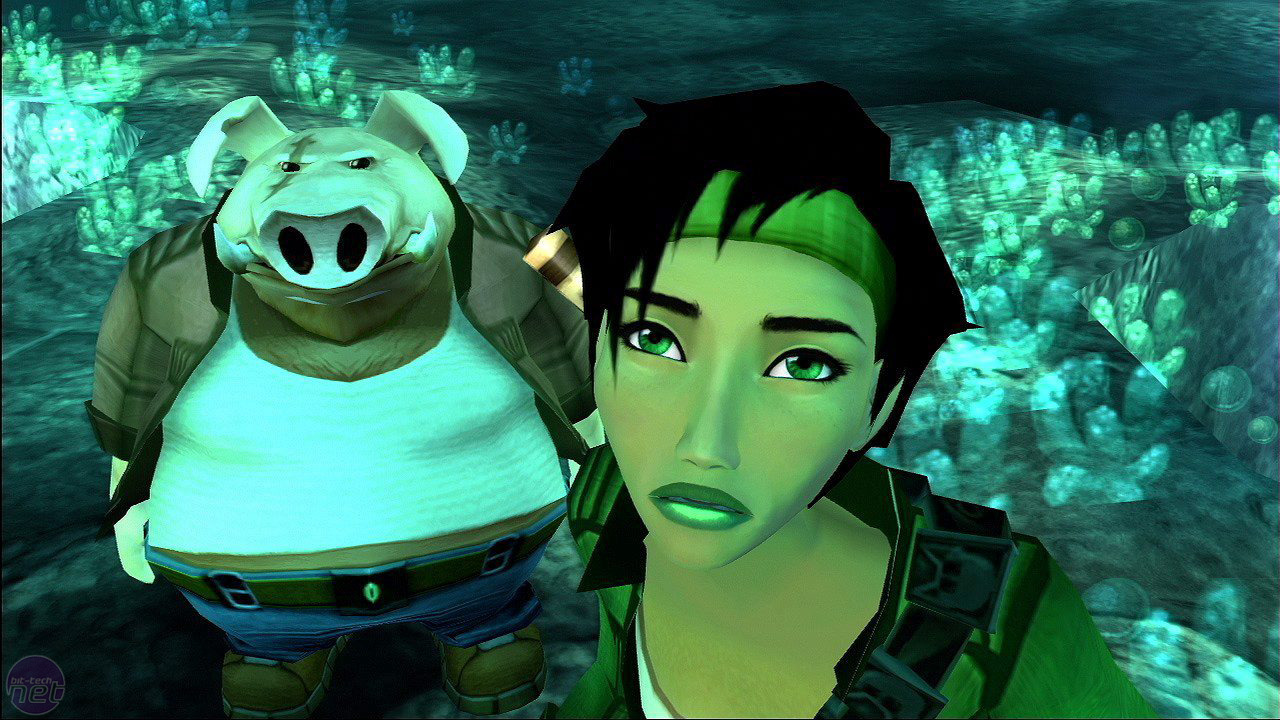
So, Beyond Good & Evil (BGE) was pretty damn fun. Actually, playing both of these games reminded me of ye olden tymes when there was the occasional AAA game that had a really interesting setting, a legitimately engaging gameworld. BGE has such a charmingly idiosyncratic sci-fi/cartoon/steampunk/sort-of-Madagascar world that I found myself really wanting to explore it.
Like Disney, but with redneck Han Solo in boar form.
Fortunately, the game follows this up with excellent mechanics, so exploring its semi-open world is a joy. It's a game that's fun to play not necessarily because of any particularly innovative or brilliant mechanic, but more because it offers a number of different game modes and all of them work pretty well. Like a lot of more modern games, BGE lets you fly a spaceship, race a hovercraft, explore dungeons, battle using a melee weapon, solve puzzles using a rhythm-based combat move, stealth your way into enemy military bases, take photos, talk to townsfolk, go shopping, talk to your party mates...and I could probably go on if I thought hard enough. All of these things (except, arguably, the hovercraft) feel pretty natural, are easy to pick up without having to learn a lot of complicated controls, and perhaps most importantly all fit well in the game's world. When you suddenly have to start flying a spaceship, it seems like a natural progression in the game's story, and in your role as the puppet-master rather than a developer throwing another toy at you to keep you playing for another five hours.

In addition to the world-fun and the game-fun, there's some story-fun to be had. The story, looked at in broad strokes, isn't particularly unique or compelling, but the voice acting, the (admittedly 2003) cutscenes, and the excellent writing make for a memorable cast of characters. Many of the game's most compelling moments come from character-on-character interaction: this is a game that's not going to pull back emotionally when it comes to dramatic punches because a) it's a cartoon or b) it's "just a game." There's some powerful stuff here, and that alone is almost worth the price of admission.
Get ready to feel some fucking boar-feelings!
If there's a downside to BGE, it's that it falls a little too much in love with its stealth-based sneaking gameplay in the latter half of the game. Having to sneak through large, open rooms and past guards happens way too frequently, considering that the game doesn't provide any sort of feedback to show how close you are to being seen or the degree of danger you're in. The camera usually swings around nicely to frame the stealth puzzles cinematically and this generally highlights the sightlines of the bad guys and the potential points of egress. But otherwise, you have no idea when you're going to fail, and when you fail (and you will), you may not necessarily understand why you failed. When you fail, you pretty much always get killed immediately: at first a large group of difficult-to-defeat armored guards descend on you en masse, and later on they just call in an airstrike from hovering laser-drones, which are a one-shot kill and are undodgeable. So, being seen for the last quarter or so of the game is a death sentence. This makes a lot of the stealth sequences trial-and-error in the "you die and die and die and figure it out eventually" sense.

Ultimately though, it's a great game with engaging gameplay and a fascinating and convincingly realized world marred ever so slightly by the old "too many cooks in the kitchen" problem. But not so much that you shouldn't but it immediately and play the fuck out of it.

Oh, and the protagonist is a woman who wears fairly sensible clothing and isn't made entirely of breasts.

Anachronox
Oh, shit. Anachronox. A game I've wanted to play since pretty much ever, but missed when it was first out on account of having a slow computer, then ignored for awhile due to apparent issues with getting it to run on a new computer, then finally purchased through GOG. This game is, in its own way, the most infuriating game I've ever played in my life. That's because it presents you with an absolutely amazingly written and voiced sci-fi epic that is as satisfyingly genre-correct as it is occasionally bizarrely unique (for example, one of your party members is an entire planet). It also gives you a visually consistent, convincing and striking universe for the game's sprawling story to unfold in. Then it makes you play a stupid, repetitive, almost gloatingly simplistic and slow-paced game to experience the story and the world it takes place in. Anachronox has a fan-made movie version in which all the game's cinematics are stitched together to tell a pretty effective version of the game's story while cutting out the gameplay entirely. That says a lot to me. To say this game isn't fun to play would be like saying having fire ants devouring your balls was mildly unpleasant.
Yep.
This game is not fun because:

1. There's about 400% too much backtracking, revisiting old locations, etc.

2. The characters just move too slowly. It takes forever to get from place to place, and when you want to move from one planet to another (which you do often) you need to walk all the way to a specific location on the planet you're currently visiting to change planets. When you want to change party members (also a frequent occurrence), you have to travel to a specific location in a specific planet, which for no necessary reason is also a far walk from that planet's spaceport. If you played this game as efficiently as possible, fulfilling only the primary objectives and nothing else, I'd estimate that 30% of this 30-40 hour game would still be traveling back to places you're already been and fighting battles you've already fought. Not knowing the most efficient route myself and needing to explore all options to complete a lot of the game's obscure quests, I'd estimate I spent about 80% of my first 15 or so hours backtracking, talking to the same NPCs over and over again, fighting the same battles over and over again...until I just downloaded a walkthrough and followed it for the rest of the game.

3. You either have to complete a lot of the game's esoteric subquests (which are obscure to the point of hilarity at times) or find a way to grind XP (hint: there is none) before you can even have a slight hope of being leveled high enough to finish the game. Many of the most obscure quests give you better weapons, which you need because without them you can't even hit your foes on a regular basis, let alone do significant damage to them. Most of these weapons can only be found during quests and can't just be bought somewhere. As a result, near the end of the game, I had a massive amount of money with no reason to spend it on anything, while I was undertaking hour-long quests just to get better weapons for my characters so I could actually defeat the monsters in the final dungeon (the final dungeon requires the use of two parties of three characters, which means you have to fully arm all your party members and not just max out a few favorites).

4. Battles are tedious. They're basic, FFVII-style ATB system battles, but they're painfully slow. There's an attempt at variety and tactics, but what it really boils down to is: 1) you get limit breaks, 2) you can move your characters on a hex-like field, but this never really plays a role other than as a novelty, 3) you can use magic spells but this drains your ability to boost your HP with shields...but this just remains a basic either-or proposition for the whole game, so again there's no real strategy here, 4) turns move incredibly slowly, 5) you and your enemies miss your attacks around 20-30% of the time, so battles last even longer, and 6) toward the end of the game, you're introduced to what's essentially a materia system, but the tutorial absolutely sucks and I found myself just not using the system at all...and you know what? It didn't matter. I beat the game just fine without ever learning it.

There are other things that I could rant about, but you get the idea and I'm tired of complaining. Honestly, I wanted to like this game. This game, with an entirely different game at the heart of it, would have been amazing. There aren't and haven't been many other games I've ever played with such a sense of place and such an excellent story and well-acted characters (except, maybe, BGE). But it is just so goddamn horrific to play that I can't honestly recommend it.

THESE ARE WORDS ABOUT SOMETHING I DON'T WANT TO HATE BUT HATE

ANACHRONOX!!!

Oct 14, 2013

How (Not) To Talk About Digital Culture In A Classroom Full Of Teenagers

So I'm having a fascinating/frustrating issue with one of my classes at the moment. The course is titled "Digital Diversity," and it's a course I've kind of ported over to Oregon Tech from a 400-level DTC course I taught at WSU. The premise is that it's basically (as I say in meetings) "a cultural studies approach to the internet": in this version of the class, we look at how the internet and "always-on" technology is effecting our personal sense of identity and the ways we interact with others. Later on in the course, we move on to talking about internet access issues (often occurring along class/race lines), the ways social media is changing the face of political activism, and how old cultural/race/gender biases persist in virtual communities.

But none of that matters because we can't seem to stop talking about the robot apocalypse.

Well, that's not entirely true. What's really happening is that I've been trying to use Sherry Turkle's book Alone Together, which I really like, to introduce some perspective on how dramatically our modes of socializing and professionalizing and pretty-much-any-other-izing have changed in the last decade or two. It's a really good book, from my perspective, and Turkle, who's been writing about these issues almost longer than I've been alive, uses a lot of direct interviews to make her point that there's a serious gap between the most recent adult generation in this country and us older folks in terms of how invested people are in their technology and how thoroughly it permeates their everyday lives.
Seriously you guys, it's pretty good.
Anyway, the students (in general, at least) just aren't digging it. Their responses generally fall into one of three camps: 1) The people Turkle interviews are extreme examples of tech use and therefore she's not honestly portraying our culture in general, and/or 2) Technology is just going to become more and more widespread, there's nothing we can do to stop it, so why question it? and/or 3) It's just Facebook, why bother talking about it?

Ugh:

1) The way this concern is usually, actually phrased is "The people Turkle interviews (game addicts, online bullies, pretty normal-seeming teenagers) aren't normal people. If she interviewed normal people, it wouldn't seem like technology was so bad." Well, there's a shitload of problems with this statement, but let's just deal with the top layer. First off, any course that features, at its core, the goal of helping students develop critical thinking skills obviously has more work to do when students are making this kind of comment, wherein "normal" pretty obviously means "the way I am." Second, at least two thirds of these "normal" students, who don't have any "issues" with technology, can't seem to pull their faces out of their phones long enough to pay attention when I'm lecturing about the technology overuse that's apparently only an issue for complete, unhinged maniacs. Wait, what? Third, in my generally limited experience of the world, the people Turkle is interviewing are "normal," inasmuch as anyone is. Rest homes use robots to cheer up old people now. People are intrigued by the idea of having a lifelike but ultimately mechanical significant other so they don't have to navigate the "messy" parts of a human-on-human relationship. People are so addicted to the haptic feedback their phone gives them that they're feeling phantom vibrations in their pants whenever the phone isn't there. I think we're well past the point where claiming that a life dramatically mediated by technology is something only lunatics experience. To me, Turkle's book didn't talk about some weird robot sex utopia that won't ever exist anywhere; it talked about what was happening in my classroom while I was trying to talk to my students about the book. The question, of course, is do the students just not see the degree to which they're immersed in technology and thus perceive others who are, for all intents and purposes, just like them as non-"normal" somehow? Or am I just generationally biased?
2) This and 3) are sort of one of a piece. The whole "These things are happening, and we can't stop them!" thing is frustrating, but it's also a difficult thing to confront productively. It shows a sort of misapprehension of what the entire course is about, which might be (and probably is) a reflection of my not teaching it perfectly as much as it is a reflection of the students not "getting it." We're certainly not going to stop American culture from traveling down the path Turkle charts by bursting out of the classroom armed with Knowledge and Resolve; nor should we. The purpose of the class, the purpose of criticizing something, isn't to pass a verdict on whether or not it should exist, whether it should happen to the utmost extreme (robot sex!) or be erased from the face of existence (EMP explosion!), but rather to question the direction of our cultural momentum so that we, as individuals, can respond to it more intelligently and constructively, rather than getting swept along with the larger momentum unquestioningly. Yet it's hard to get the students to understand that criticism doesn't equal dismissal or rejection. Maybe equating those things is just a teenager thing. I can't remember.

3) I've had trouble with this one ever since I started teaching media other than just books. Students, somehow, are programmed at an early age (apparently) with the idea that taking an old book by a dead white guy and scrutinizing the everloving fuck out of each word in it is just a Thing You Do. Expect them to do this with video games, or films, or god forbid, smartphone apps and they lose their goddamn minds. Again, this isn't necessarily anyone's fault, but it's hard for me to figure out how to teach critical thinking about these forms of expression. There's no way to force them up to the high-culture level of literature in a few weeks of class, and yet everything that's not worthy of this sort of highbrow consideration is "just a game" or "just an app." As if something that mediates your relationships with other people and takes up 5 hours of your day is "just" anything. Hmph.
Sorry if this post comes off as overly pissy; it shouldn't. I'm not mad at anyone, I'm just having a hard time, as usual, getting students to believe that the culture they currently live in is just as interesting and worthy of study as the cultures that existed centuries ago.