Showing posts with label computers. Show all posts

Nov 10, 2013

Linux Mint Wants To Be Your (Work) Friend

Note: This was cross-posted on Recomposing the Pines today.

It's true. I won't go into depth on why it's true, I'd rather leave you to figure that out yourself if you're so inclined. But I wanted to do a little mini-post here simply to say that I've been using Linux Mint (first version 13 and then version 15) for all of my work-related tasks since mid-summer, and it's been absolutely fine.

A lot of people seem to have the perception that Linux = Difficult, or that you have to be some sort of crazy computer whiz to be able to use it. I say this because that was exactly my perception until I tried out Mint.

There are, it turns out, a lot of different distributions of Linux. Many are obviously built to serve particular purposes (for example, Puppy Linux is built to work well on old computers and netbooks, but has less flash and functionality than something like Ubuntu). Many are unique in ways that would be basically unnoticeable to the non-guru, but are, I'm told, mightily significant to The People Who Know Computer Things.*

But, generally speaking, Linux is appealing to a certain kind of person (read: "not just a computer person") because it is the early-90s, manual-transmission car of the operating system world. At a time when it's getting harder and harder to look under our "car"'s hood and find the radiator, to learn to change the oil by ourselves, or to diagnose a fluid leak without hooking everything up to a computer, Linux still has an easily navigable, wide-open space under the hood, easily identifiable and removable (and installable) parts, and so on.

Obviously, in this metaphor, a lot of people are going to prefer to have a car that "just works." Of course, that is, until it doesn't work, in which case you either have to take it in to the mechanic (Windows) or just buy an entirely new car (Mac). But if you have a modicum of interest in at least slightly understanding the machine in front of you that likely contains your entire professional (and maybe personal) life and on which your ability to discharge your workday responsibilities relies, Linux gives you a foot in the door.

Mint, specifically, is built to mimic the Windows UI (pre Win7) in a lot of ways. It comes prepackaged with a lot of software and drivers, to the point that if you're one of those weirdos who can happily sit at a work-provided computer for years and never think about installing new software, or changing your desktop background, or changing the arrangement of the taskbar icons.
Mint 15 UI with the taskbar and an image preview open.
I've never really had any trouble with Mint on install before, and I've installed it on five different computers now, from three different manufacturers. The only times I've had issues that required some serious troubleshooting was when I started trying to install new programs, change system settings, etc., and most of those "errors" and system failures were more a result of my own clueless flailing around than any inherent instability in Mint.

Fortunately, basic functions work well "out of the box," as it were, and pretty much all the software you'll need to perform typical work-related tasks are already installed, and your sound, graphics, etc. should work right away, to a surprising degree. I installed Mint recently on a two-monitor setup in my new office, and both monitors came online immediately -- something that didn't happen even when I installed Windows 7 on the same computer.
Different is terrifying!
I guess the big catch for using Linux for typical work tasks would be that you'll need to learn how to navigate some programs that are going to be a little different than what you're used to. For example, there is no Microsoft Office. There is, however, LibreOffice, which for my money is faster, more reliable, and nicer-looking than MS Office anyway.
Plus, it can save documents, slide shows, spreadsheets, etc. in all the typical Microsoft formats, so you can pull the same documents up later on a computer in the meeting room and have them run just fine. Admittedly, sometimes there's some formatting, etc. lost in the process of moving from LibreOffice to MS Office or vice versa, but honestly I've never had as much trouble as I've had moving from, say, MS Office 97 to 2003 and back or 2003 to 2010 and back, and so on.

If you want to try Linux Mint, but not totally commit, the site I linked to above will explain how to make a LiveCD and boot your computer from it. In this state, you'll be able to play around with Mint "on" the CD, so there are no changes made to your computer while you test it out and see how you like it. If you want to install Mint alongside Windows 7 (or lower), so you're not making One Big Choice as much as letting yourself make the choice every single time you boot up the computer, you can do this. In fact, this is how all my computers are set up: they start up to a simple menu at which I choose either Linux (for 95% of my day-to-day tasks) or Windows (for the occasional movie-editing or sound-editing task that it does better than Linux, plus video games). There's a really easy-to-follow tutorial for this, which is right here.

Anyway, once I got everything installed, I found Mint to generally be more reliable, faster, and better-looking than Windows, at least as far as doing the typical word-processing, emailing, and messaging tasks that I do at work every day. I boots up way faster, too.

If you want to explore the system a little bit more, it actually lets you, too, and as long as you don't jump into doing things like editing system kernels right off the bat, the learning curve is pretty shallow and there's a number of great communities online that are willing to help you figure things out and answer newbie questions.

Oh, plus everything's free. I suppose I should have mentioned that before. Mint itself is free, and all the software that comes with it is free. All the programs you might want to install are free. Don't like the default music player? There are literally hundreds more to choose from, and none of them cost a cent. The Adobe Photoshop analogue? Free. High-end music editing programs used by real DJs? Free.

You get the idea.

Anyway, just something to think about. Switching to Mint will likely stretch your brain just a little bit, but in a good way. Plus, over the last few months I've come to find that it's not just a good alternative for work than your typical paid operating system, it's actually better in a lot of significant ways.

* I finished my undergrad a measly nine credits short of a Bachelor of Science in Computer Science, and do not consider myself smart enough to be counted among these people.

Oct 22, 2013

(Not So) Defiantly (Maybe): Profile Fatigue and Why I'm Hiding My Blog From You Now

Note: This was cross-posted on Recomposing the Pines today.

So, tonight marks sort of a big moment for me and my relationship with the internet.

I started my first blog in December of 2004, and ever since then, first on Livejournal, then Blogger, then Tumblr, and then Blogger again, I've written whatever came to mind about whatever came to mind, and left it all available for anyone to read, both in the interest of generating discussion and as an exercise in self-expression. Before blogs, before social networking was a thing, I wrote pretty consistently (both fiction and just general thoughts) on my computer from 1995 or so up until 2004, and though there wasn't as ready a mechanism for making those writings widely available at the time (thank god!), I was willing to share them with whoever was interested.

As of tonight, I'm changing my primary blog over to private, so the entries can only be read by people who I've personally okay'd. Here's why.

One of my absolute favorite times to be doing anything on the internet was when I was blogging c. 2006-2008. Facebook wasn't a huge thing yet (at least not in my social circles), I had a MySpace, but it was a secondary form of communication, for the most part, to email, and blogging was fun. I've never had a large readership on any of my blogs, but I never wrote for other people, just for myself, so that wasn't a big worry. What I did have were a few friends who followed my posts, occasionally responded to something that interested them directly, and often blogged in their own right. Not only did it feel like I had a small, invested group of friends/readers who would take an occasional personal interest in what I was writing (an important thing for an insecure writer, thinker, and human), I was allowed access to their thoughts in kind, and some of the most interesting conversations I've ever had arose from back-and-forth comments during this time. These experiences were in large part what led to my declaring, when I started writing professionally on new media issues, that relationships and communication online could be just as meaningful and "deep" as those offline.

Then something changed. It would be reductive to say that the impetus for this change was the rise of Facebook, but that certainly had something to do with it. Suddenly, nobody (including me, much to my own surprise) read blogs anymore, and took to reading status updates instead. More importantly, nobody used blogs to communicate anymore, but took to writing status updates instead.*

This change wasn't as immediate as I'm making it sound, but at some point in 2009, I realized I wasn't really blogging as much anymore, and people weren't responding anymore. I still had conversations with the same people, but they were on Facebook (and later on Twitter). These conversations were, by necessity, faster but also shorter, at times near-synchronous but oddly unsatisfying for all that. Blogging started to seem like something that took too much effort, when other, faster methods of online communication were so readily available. In 2008, I posted 723 times on my blog. In 2009, it was down to 378. By last year, it was down to 32.

Obviously, this wasn't some sort of dystopian disintegration of virtual community. It didn't happen to me; I just stopped writing, albeit slowly over the course of a few years. For one thing, I was working harder at grad school, I was in a relationship, I had more friends in "the real world," and I was spending a decent amount of time virtually socializing on Facebook (and later Twitter) each day as it was. I had hobbies and other interests, and it seemed natural that pursuing those hobbies and interests was of primary importance, while sitting in front of a blog writing about pursuing them should be of secondary importance. It wasn't until last week, in the midst of a discussion with my Digital Diversity students about Sherry Turkle's new book Alone Together that I realized how drastically things had changed: I realized, in the midst of one student's particularly strident defense of texting as an emotionally nuanced form of person-to-person conversation, that relationships and communication online was not as meaningful or "deep" as "real world" interaction, at least not for me. Not anymore.

I don't have any fancy academicese to back this up with at the moment, and I don't really want to cast about for any. I don't need it. That golden age of blogging is gone, and it's been replaced by a fistful of different social media profiles, a tangle of different audiences, all with their own expectations of me as a writer, and as a person, and it feels more and more, day to day, that my interactions on Facebook and Twitter, even with my best, dear friends from "real life" are really just a series of carefully calculated acts, impression management, with at least one eye always toward a bigger audience that might or might not be watching. And it feels like it's sucking all the fun out of this whole internet thing.

Now, obviously, I'm not going to stop using Facebook, or Twitter, or blogging (clearly). I study these things for a living because they're interesting to me, and they're just as fascinating when they don't work as they are when they do work. But. I can't help but feel more and more as time goes on, that a lot of my time spent on social networking sites is just sort of a waste. I have a very difficult time having meaningful conversations with real human beings over a medium like Facebook ("meaningful" academically, philosophically, emotionally, comedically, whatever). Everything is bite-sized pieces of information that people (including me!) have a tendency to attach planet-sized amounts of meaning to, and if you try to explain a point of view or opinion or whatnot "at length" (by which I mean "in the amount of text you might be able to speak in 45 seconds), half the comments that follow are "TL;DR lol" or similar. I'm not a huge fan of what it's done for our discourse. It seems pretty often that your options for communication on Facebook are: 1) talk about very trivial things constantly and 2) try to talk about something more substantive, but spend most of the following thread defending yourself from wild misinterpretations of what you were trying to say from generally well-meaning people who naturally project their own agendas onto your comments on a site that's really all about self-absorption (I'm just as guilty of this as anyone else, of course).

It's not that I have anything against trivial conversation. Between the ages of 16 and 32, the percentage of my daily conversations that end up being about bodily functions has only slightly decreased from 70% to about 55%. But I don't like the fact that after a day of trading Facebook/Twitter info-bites, the idea of writing a long-form blog post deeply exploring some issue seems like "too much." I don't like that I would rather refresh my News Feed for the twentieth time instead of reading a few pages out of a book that's been sitting on my desk for a month, gathering dust. Clever and funny as they are sometimes, I don't want to think in memes for the rest of my life, even if the instant-gratification part of my brain keeps trying to convince me I do by pumping me full of dopamine.

When I have a particularly full day at work, or some other professional/personal/emotional difficulty, I really enjoy going for a walk or a jog, or even a drive (without music). It's about the only way I've found to give my brain space to sort through the knots and try to make sense of what's going on so that I can respond to stress productively. I love climbing mountains; it's a beautifully rewarding hobby to have, both physically and spiritually. But half of what makes me get out there and do it on a regular basis is it's one of the few ways I have nowadays to actually get away from all the Facebook-level stuff (both online and in "real life") and let my brain process at what feels like the actual speed a brain should be allowed to process at. I still have some spaces like this in the physical world, clearly. And I really appreciate them, because they keep me from going nuts. I used to have a space in the virtual world like this as well, but then me and everyone else stopped going there. I'm still not sure why, but now, finally, I know that I wish we hadn't.

So what does making my blog private have to do with this?

An even more important question might be "Why are you still reading this?" But I digress.

I want to have a chance to reestablish this lost virtual space. Doing that means that I need to set up my online presence in such a way that I'm encouraged to write long-form posts again instead of the shorter, spur-of-the-moment content that social networking requires. To do this, I need to have at least one space where I know my audience and feel like I'm able to screw up in front of them without being harshly judged. At one point in my life it was important for me to prove to myself that I could be honest about who I was publicly, in front of anyone who happened to stumble across my blog. I know I can do this now. Now, I worry about losing a friend, a colleague, or a job over saying too much in a virtual space where we've all agreed to only say very little.

I write about a lot of things. Most of them are stupid. Some of them might be smart, but I doubt it. But I enjoy this, and, like going for a walk, it helps clear my head. It helps even more if certain people are willing and able to chime in with constructive observations along the way. And maybe the worst part of the blog-to-Facebook transition is not the dumbing-down of post content, but the fact that there's no easy way to share with these people without sharing with everyone you've ever friended, or with everyone who's ever chosen to "follow" you. This, I believe, fundamentally alters the way in which we perceive of our own identity formation and our written communication with others. No, seriously.

In the past, if you wanted to be weird, foul-mouthed, juvenile-y poetic, or even (the worst sin when all your online friends are academics!) self-contradictory, you could probably get away with it as long as you were audience-literate and made sure that each of the selves you presented to different people/groups was consistent for the particular audience you presented it to. Now that option is gone. The people who know the Facebook You also know the Physical World You. The people who read your tweets also sign your paychecks. And so on. People can say "Oh, just be yourself!" or "Just use Facebook Lists!" or "Just don't put anything stupid online!"

To these I say, in order:
1) The world must be a wonderfully uncomplicated place for you, random 13 year-old objector!

2) These sorts of workarounds are possible, for sure, but notice how they're always fairly complicated to enact. It's almost as if the people behind the social networks don't really have any interest in making it so you don't share everything with everyone all the time...

3) Well, then what's the point of being online? What's the point of socializing at all if you're not going to say anything interesting, make a few mistakes, learn from them, and then make a few more in the process of being a human being?

Back in the old days, we socialized in private. We talked on phones, we hung out in rooms, we passed notes that were quickly disposed of, lest our various social circles intersect, with disastrous results. The sender of the message and the receiver understood the rules of the particular circle that they shared: some circles were playgrounds, some were deadly serious, many were in-between. You could tell a friend about a serious misgiving you were having about, say, your current relationship and get some meaningful feedback as well as a little discretion. Now imagine having this same conversation in the middle of a restaurant completely full of people you know while your friend sits at the other end of the room and the only way you're allowed to talk to him/her is by using a megaphone set to full blast. It's easier to not talk at all.

And that's what I worry about, at least for myself, if not for Today's Society at large: that these "heavy" conversations are happening less and less because it's just difficult to have them within the logistics of online impression management. Certainly, not all talk goes on online, but more and more of it does. Research from the aforementioned book by Sherry Turkle shows teens growing up today frequently prefer texting to phone calls because the phone "gives too much away": emotions can be betrayed, information is conveyed through the voice, breathing, inflection, and it's much less scary to be able to perfect the presentation of your message, of yourself, by writing a text, posting on Facebook, etc.

This scares me. If people aren't willing to let the "information" of emotions into their discourse because it's "easier" to reduce everything to text, short paragraphs, soundbites, then it can't be terribly far from here to the point where bothering to think about difficult things becomes inconvenient enough that we simply prefer to pretend our problems, our brain-knots as it were, don't exist. Some people might be okay with this, and that's fine. This isn't a call to arms by any means. I'm not okay with it, though, not for me, and I'm hoping to get back to something that strikes me as a more holistic form of online communication and expression in the hopes that it'll bleed back into my "real life" a bit. I guess what I've been trying to say is that my day-to-day life is, to the smallest but scariest degree, starting to resemble Facebook. When I write in tweets all day, I start thinking in tweets all day. And there's too much world out there for tweets to contain.

Obviously, I'm going to keep using social networks. For one thing, they're part of what I study. For another, there's a lot of social inertia built up there; if I simply disappear from the FaceScape, Bad Things will happen personally, professionally, etc. I spend the majority of my 50 or so hours of work per week in front of an internet connected computer, and it's fun to tab away from work from time to time to throw up an observation on Facebook or a photo on Twitter or Instagram. But, as I said above, these networks are, from my perspective, mostly about the self, built on the supposition that if you have something to say, not just someone but everyone you know is potentially interested in hearing it. I think that's pretty rarely true (at least for me), and I don't write to get people's attention. 95% of the posts I make on social networking sites are made to specifically inform a few people of something (to share pictures with my parents, to let a few of my friends know where I'm going to be in 4 hours, etc.); it just so happens that because we're all in the same restaurant and all I've got is this damn megaphone, everyone else gets to hear, too, whether I/they like it or not.

So I want to go back to having a space where I know who I'm writing to, just one space, because I think that might just make a lot of difference for me. I've created a new blog, Recomposing the Pines, so that I can continue to cross-post academically relevant and publicly-appropriate thoughts (and then, yes, share those thoughts on Facebook and Twitter), but Defiantly, Maybe will be invite-only.

And yes, I realize the irony of making yet another blog as a response to profile fatigue, but whatever. This felt right, so I'm giving it a shot.

The reason I really wrote all of this, if you're still with me, was to say this: anybody who is interested in reading my old, less orderly and less presentable blog: I would absolutely love for you to. I'll continue posting, hopefully more frequently and more freakishly now, and we'll probably all have a good ol' time together. You don't have to comment, you don't have to post back; just knowing people are reading is a neat thing, and will likely keep me more interested in keeping the project going than if I'm just writing into (virtual) space. Get ahold of me in whatever way is easiest, and I'll add you to the reader list. I know there are a few of you out there who still read that blog now. If you can bring yourself to click a few times on the internet on behalf, I would like to add you to the reader list, because you are all awesome and I like having you read my stuff and things. I would be sad if you got shut out at this point. For the 95% of you who aren't interested in the weirdo-Ben blog at all, awesome! You can do nothing at all and your reward will likely be having your Facebook and Twitter feeds a little more free of my inane rambling. What a deal, right?!

I'm certainly not doing this to hide anything (except the GPS coordinates of the bodies), but instead to just make sure I know who's looking when I jump from video game reviews to webcam videos of yoga ball Plinko to the blog equivalent of going on a walk to clear my head all in the space of a week. The web used to be a wilderness and now there are fences everywhere and gates and fees and frowning police officers and it'd be nice to just have a little piece of land to build something that's just mine again.

Is that stretching the metaphor too far?

Ah, overburdened metaphors and pages and pages of rambling text typed in the middle of the night. It's already starting to feel like old times in here...

Thanks for paying attention, and at the very least look for future academic-y, smart-people discussions about pedagogy and new media and conferences and whatnot on Recomposing the Pines!

* I should clarify here that when I say that "nobody was reading/writing blogs anymore," I mean specifically as a means of general, day-to-day narration and mundane philosophizing. Of course blogs continued to be (and continue to be) a popular medium in other contexts.

Oct 16, 2013

Reviews: Beyond Good and Evil and Anachronox (PC)

So, I haven't done any reviews for awhile. This is mostly because I've been playing Anachronox for pretty much ever. This is a good and bad thing. Mostly bad, though. I think.

Beyond Good & Evil
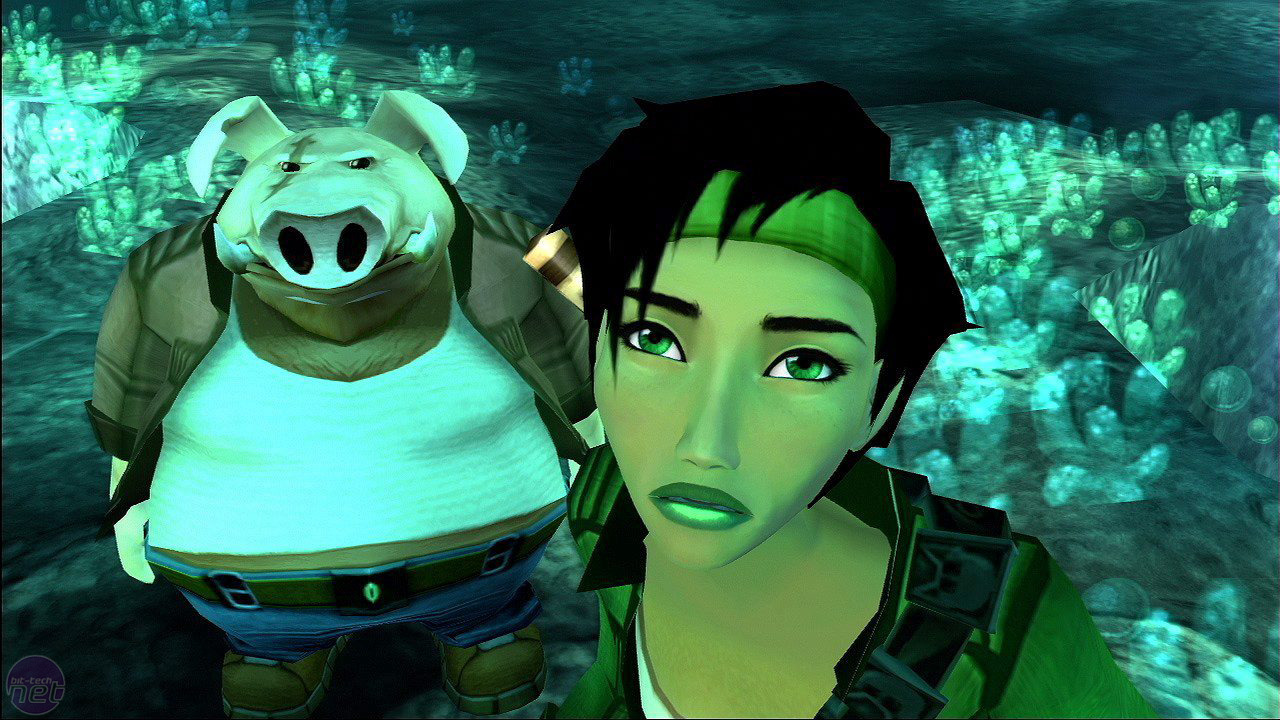
So, Beyond Good & Evil (BGE) was pretty damn fun. Actually, playing both of these games reminded me of ye olden tymes when there was the occasional AAA game that had a really interesting setting, a legitimately engaging gameworld. BGE has such a charmingly idiosyncratic sci-fi/cartoon/steampunk/sort-of-Madagascar world that I found myself really wanting to explore it.
Like Disney, but with redneck Han Solo in boar form.
Fortunately, the game follows this up with excellent mechanics, so exploring its semi-open world is a joy. It's a game that's fun to play not necessarily because of any particularly innovative or brilliant mechanic, but more because it offers a number of different game modes and all of them work pretty well. Like a lot of more modern games, BGE lets you fly a spaceship, race a hovercraft, explore dungeons, battle using a melee weapon, solve puzzles using a rhythm-based combat move, stealth your way into enemy military bases, take photos, talk to townsfolk, go shopping, talk to your party mates...and I could probably go on if I thought hard enough. All of these things (except, arguably, the hovercraft) feel pretty natural, are easy to pick up without having to learn a lot of complicated controls, and perhaps most importantly all fit well in the game's world. When you suddenly have to start flying a spaceship, it seems like a natural progression in the game's story, and in your role as the puppet-master rather than a developer throwing another toy at you to keep you playing for another five hours.

In addition to the world-fun and the game-fun, there's some story-fun to be had. The story, looked at in broad strokes, isn't particularly unique or compelling, but the voice acting, the (admittedly 2003) cutscenes, and the excellent writing make for a memorable cast of characters. Many of the game's most compelling moments come from character-on-character interaction: this is a game that's not going to pull back emotionally when it comes to dramatic punches because a) it's a cartoon or b) it's "just a game." There's some powerful stuff here, and that alone is almost worth the price of admission.
Get ready to feel some fucking boar-feelings!
If there's a downside to BGE, it's that it falls a little too much in love with its stealth-based sneaking gameplay in the latter half of the game. Having to sneak through large, open rooms and past guards happens way too frequently, considering that the game doesn't provide any sort of feedback to show how close you are to being seen or the degree of danger you're in. The camera usually swings around nicely to frame the stealth puzzles cinematically and this generally highlights the sightlines of the bad guys and the potential points of egress. But otherwise, you have no idea when you're going to fail, and when you fail (and you will), you may not necessarily understand why you failed. When you fail, you pretty much always get killed immediately: at first a large group of difficult-to-defeat armored guards descend on you en masse, and later on they just call in an airstrike from hovering laser-drones, which are a one-shot kill and are undodgeable. So, being seen for the last quarter or so of the game is a death sentence. This makes a lot of the stealth sequences trial-and-error in the "you die and die and die and figure it out eventually" sense.

Ultimately though, it's a great game with engaging gameplay and a fascinating and convincingly realized world marred ever so slightly by the old "too many cooks in the kitchen" problem. But not so much that you shouldn't but it immediately and play the fuck out of it.

Oh, and the protagonist is a woman who wears fairly sensible clothing and isn't made entirely of breasts.

Anachronox
Oh, shit. Anachronox. A game I've wanted to play since pretty much ever, but missed when it was first out on account of having a slow computer, then ignored for awhile due to apparent issues with getting it to run on a new computer, then finally purchased through GOG. This game is, in its own way, the most infuriating game I've ever played in my life. That's because it presents you with an absolutely amazingly written and voiced sci-fi epic that is as satisfyingly genre-correct as it is occasionally bizarrely unique (for example, one of your party members is an entire planet). It also gives you a visually consistent, convincing and striking universe for the game's sprawling story to unfold in. Then it makes you play a stupid, repetitive, almost gloatingly simplistic and slow-paced game to experience the story and the world it takes place in. Anachronox has a fan-made movie version in which all the game's cinematics are stitched together to tell a pretty effective version of the game's story while cutting out the gameplay entirely. That says a lot to me. To say this game isn't fun to play would be like saying having fire ants devouring your balls was mildly unpleasant.
Yep.
This game is not fun because:

1. There's about 400% too much backtracking, revisiting old locations, etc.

2. The characters just move too slowly. It takes forever to get from place to place, and when you want to move from one planet to another (which you do often) you need to walk all the way to a specific location on the planet you're currently visiting to change planets. When you want to change party members (also a frequent occurrence), you have to travel to a specific location in a specific planet, which for no necessary reason is also a far walk from that planet's spaceport. If you played this game as efficiently as possible, fulfilling only the primary objectives and nothing else, I'd estimate that 30% of this 30-40 hour game would still be traveling back to places you're already been and fighting battles you've already fought. Not knowing the most efficient route myself and needing to explore all options to complete a lot of the game's obscure quests, I'd estimate I spent about 80% of my first 15 or so hours backtracking, talking to the same NPCs over and over again, fighting the same battles over and over again...until I just downloaded a walkthrough and followed it for the rest of the game.

3. You either have to complete a lot of the game's esoteric subquests (which are obscure to the point of hilarity at times) or find a way to grind XP (hint: there is none) before you can even have a slight hope of being leveled high enough to finish the game. Many of the most obscure quests give you better weapons, which you need because without them you can't even hit your foes on a regular basis, let alone do significant damage to them. Most of these weapons can only be found during quests and can't just be bought somewhere. As a result, near the end of the game, I had a massive amount of money with no reason to spend it on anything, while I was undertaking hour-long quests just to get better weapons for my characters so I could actually defeat the monsters in the final dungeon (the final dungeon requires the use of two parties of three characters, which means you have to fully arm all your party members and not just max out a few favorites).

4. Battles are tedious. They're basic, FFVII-style ATB system battles, but they're painfully slow. There's an attempt at variety and tactics, but what it really boils down to is: 1) you get limit breaks, 2) you can move your characters on a hex-like field, but this never really plays a role other than as a novelty, 3) you can use magic spells but this drains your ability to boost your HP with shields...but this just remains a basic either-or proposition for the whole game, so again there's no real strategy here, 4) turns move incredibly slowly, 5) you and your enemies miss your attacks around 20-30% of the time, so battles last even longer, and 6) toward the end of the game, you're introduced to what's essentially a materia system, but the tutorial absolutely sucks and I found myself just not using the system at all...and you know what? It didn't matter. I beat the game just fine without ever learning it.

There are other things that I could rant about, but you get the idea and I'm tired of complaining. Honestly, I wanted to like this game. This game, with an entirely different game at the heart of it, would have been amazing. There aren't and haven't been many other games I've ever played with such a sense of place and such an excellent story and well-acted characters (except, maybe, BGE). But it is just so goddamn horrific to play that I can't honestly recommend it.

THESE ARE WORDS ABOUT SOMETHING I DON'T WANT TO HATE BUT HATE

ANACHRONOX!!!

Sep 18, 2013

Reviews: They Bleed Pixels and Thirty Flights of Loving (PC)

MOAR reviews...MOAR!!!

They Bleed Pixels
They Bleed Pixels is unsatisfying in the way a bad ice cream sandwich is unsatisfying: while you'd certainly hoped for more, you've still gotten to eat an ice cream sandwich and so you're not going to complain. Too much.
NOW 30% MORE OF A DISAPPOINTMENT! SORT OF!
I think in reality my love/hate relationship with this game might spring from a misunderstanding on my part of what it's supposed to be. I think I envisioned the game, based on the videos I'd viewed and the reviews I'd read before buying it, as a clever beat-em-up with a Lovecraftian aesthetic and the occasional bit of jumping.
This excited me because a) I love Lovecraft and b) a beat-em-up with a good fighting system is one of my greatest weaknesses, along with side-scrolling bullet-hell shooters and Serious Sam-style FPSs. I've logged an embarrassing amount of hours playing Super Double Dragon, Return of the King, and WWF No Mercy! over the years as a result of b).

Unfortunately, if you've watched the above trailer, you've already seen the entirety of the fighting-move set you're given during the game and you've only seen a very small part of the hair-tearingly infuriating jumping sequences.

Unfortunately Part Two, the game is really not that good when it's trying to be Lovecraft-meets-Super-Meat-Boy, which is what it's trying to do for about 90% of its running time. Which brings me to a more general point that I'd like to express to all indie games: SUPER MEAT BOY IS BETTER AT BEING SUPER MEAT BOY THAN YOU ARE.
And he knows it too, that cheeky little fucker.
They Bleed Pixels's controls are just too slippery; it's never quite clear when you're going to let go of a wall, or when you're about to grab one, the timing of doing combo-heavy things like juggling are imprecise, and all too often the double-jump just refuses to work for no apparent reason. Super Meat Boy isn't great because it's bastard-hard, it's great because it can kill you two hundred times on the same level and every single time you'll know it was your fault, because the controls are precise and the way through the level is clear. If you can't get there, it's because you're not good enough. TBP is different; generally, when I died multiple times in quick succession I was reduced to that old NES standby: screaming "I PRESSED THE FUCKING JUMP BUTTON! I PRESSED IT!!! AAAAAUGGGGGGGGAGHHGHHH!?" over and over while slamming the controller into my own skull.
Me playing Unreal Tournament in 1999.
Needless to say, this is unsatisfying.

The beat-em-up part of the game was pretty excellently done, but it just felt underdeveloped. For as long as the game takes to finish, you learn pretty much all of your fighting moves by the time you're about 10% through, and by then you've also met almost all of the (rather unvaried) enemy types you'll fight as well.*

What I really enjoy about a good hyper-hard platforming game is the sense of personal accountability that comes with a really tight control scheme (and the subsequent feeling of ultimate success you get when you beat the "impossible" game anyway). What I really enjoy about a good beat-em-up game is the ebb and flow, the punch and counterpunch between you and your enemies, the mini-strategy game that's set up in the instants between button presses as a result of the complexity at work underneath the obvious layer of graphical fisticuffs. TBP doesn't provide either of these experiences. It gestures emphatically enough at each of them that it was sort of fun for its entire maybe-six-hours running time, but there's not enough variation to make it very engaging beyond the level of a quick blast of dopamine.

What was really cool was the bonus levels unlocked when I finished the game: one that was a labyrinth-like tower with a better level design than anything found in the game proper, and another that used the game's juggling mechanic to task you with luring enemies into various traps located around the level. These were twists on the game's basic mechanic that I was mentally begging for throughout the main campaign. It's strange that they only emerge during the guest-designed levels. Oh well.

*I should note here that the game dutifully doles out new "tutorial" sections to you every time you finish an early level, but they're never anything you can't just figure out on your own after a few seconds of button-mashing.

Thirty Flights of Loving
Without getting into the age-old (and fairly pointless) argument of what a "game" is, I found Thirty Flights of Loving to be less of a game and more something that you'd "read" in a college-level Short Stories class. In fact, the next time I teach 21st century fiction or something similar, we're definitely going to be "playing" TFoL. It's a really incredible experience, but not a really incredible gameplay experience. It's an experiment (it seems to me) in the use of an interactive virtual space as a storytelling medium. And it succeeds brilliantly while managing to be unlike any other "game" I've ever "played."

Okay, I'll try to lay off the air quotes now.
This looks suspiciously like the last syllable of the word "beotchhhhhhhhhhhhh."
Everything about TFoL screams "literature" to me. Maybe that's because I'm an English professor and I'm always hearing someone scream "literature," even if it's usually in an anguished tone of voice while walking into or out of my classroom. But. The experience of playing through this game is the experience of reading a short story by a master author. Except it's not a written text, or even a film, but instead it's a video game. It has its own distinct visual style, for sure:
Block heads and duck feet are two features of said style.
The music is an excellent, if eccentric fit. Much like a movie, many of the scenes and set pieces are framed; that is, you as the player view them in a particular sequence from a particular angle with a particular timing, that is repeated even during second and third playthroughs. On one hand, the almost total lack of actual interactivity (other than just walking down the hallways the game presents you with) is what makes me hesitate to call this a game, but on the other hand it's the only game I've ever played that successfully integrates smash cuts and that's fucking awesome.

Also, you can peel an orange and throw it at a pretty block-headed girl.

The game plays a lot with perspective and time (and I can't say much more without RUINING EVERYTHING), and sometimes veers gleefully off what little beaten narrative path there is to indulge in what seemed to me at first to be random wackiness but later was revealed (by my own brain on a third playthrough) as wonderfully clever symbolism.

This really isn't a game to play and then criticize the mechanics, the graphics, the "fun" level, etc. There really is no gameplay and the entire experience will take you maybe 15 minutes, tops. But, like a good but cleverly complex short story, I went back right after the end and played it through again. And again. And then again with the commentary "track" enabled. And every time I teased a little bit more meaning out of it until I was able to decide what it all (or almost all, at least) meant to me, even if that wasn't the dev's intent. The entire time I was playing, I was constantly caught up in questions of authorial intent, meaning of symbolism,
existence of through-running themes, characters' motivations, etc. And not in a "this game's story sucks, so I don't know what's going on" way, but in the way the makes a post-play discussion session with a few friends or students absolutely worth having. And that's a really, really rare thing in the world of video games. It doesn't have to be, but it is. Though that's less (I think) because of the limitations or strictures of the medium and more because to have a story that works on the level(s) of TFoL you need a Hemingway, or a Faulkner, or a Borges...someone who can actually create an experience worth painstakingly parsing for shimmering little splinters of meaning. And that's what we have here. I don't think all games should be like this. I don't think many games should be like this. I don't think many games can be like this. But this one is, and it's remarkable. I'm glad it exists.
In this particular case, the cake is NOT a...well, you know.

Reviews: Thomas Was Alone and Fez (PC)

I'm doubling up on reviews here because I've been ripping through way too many games lately, and while I'd like to get my general thoughts on each down before I forget those thoughts completely, I want to do things with my life other than blog. Like kill us all.

Just...kidding?

Thomas Was Alone
So, Thomas Was Alone was a fucking revelation. It's the rare indie experiment in minimalism that not only works, it works so well it makes you question whether the minimalist-style games you've played before actually worked as well as you thought they did when you first thought they did work.
The game is your basic jumping-and-steering platformer, with the slight twist that you solve puzzles by switching "party" members throughout. Each party member has a different ability (or abilities), and so you end up having to have them work together (i.e., Thomas isn't alone for long) to reach each level's exit. The result is a game that's part platforming and part puzzle-solving. None of the platforming nor the puzzle-solving ever reaches a legitimately challenging level, so though everything feels really satisfying (the jumping is especially well-weighted, especially when using a USB controller), by itself the gameplay would make a clever-but-not-especially-exciting platfuzzler (portmanteau police!).

Fortunately, the gameplay isn't alone, either.

The gameplay is supplemented by some of the cleverest, best-written, and best-performed voice acting that I've ever seen/heard in a game. It's simply a narrator telling the story of the your various avatars' feelings and impressions of the world they're making their way through, but somehow...someway...it manages to turn two-dimensional shapes into some of the most three-dimensional characters I've ever met in a video game.
For example, this is awesome, but you'll only understand why if you play the game.
And this makes all the difference. It's not that the game is unfun by itself; instead, this is a perfect example of what I call "worldbuilding" in my scholarly-type writing: the voiceovers flesh out the action. You guide the various shapes through the platfuzzling action, and The Voice adds an emotional context to your actions. It's a synergy between exposition and gameplay that actually works because the shapes' various personality traits (as presented by the voiceover) match their actual, physical abilities (controlled and utilized by you). The result, paired with the game's extra-abstract, weirdo soundtrack, make basically a perfect combination.

This was really driven home to me after SPOILERS the end of the penultimate chapter, wherein you lose control of the characters you've utilized (and grown to care for, frankly) for the entirety of the game up to this point, and they are replaced with new shapes, new characters, new personalities. I was surprisingly affected by this switch; I wanted to see what happened to my new friends, and the idea that theses damn interlopers would be taking their place for the denouement of the story was vexing. After about three levels, though, I was totally engrossed in these new shapes' stories. It only took me about fifteen minutes of play to get totally reinvested. It was like the devs took me out of the originally story and stoked my frustration on purpose just so they could prove how goddamn amazingly immersive the experience of playing their game was.

And they wouldn't be wrong. END SPOILERS It's awesome. Check it out.

Fez
I'm just going to spoil this one right up front: this was another one of those games that I'd heard amazing things about, paid a decent amount of money for, and then just didn't like.
Smile all you want; you cannot mute my hatred.
It started out innocuously enough: there was a little fez-guy, and he jumped around, and he could rotate the world. Cool gimmick. Really well-produced gimmick. Nice music, nice art style. But really, when it came down to it, there was no gameplay substance. I played Fez for the lion's share of two nights, and when I was done, the game told me I was something like 85% finished (or so). All I had done was run and jump and rotate, run and jump and rotate, over and over and over, through occasionally changing (and admittedly brilliant-looking) environs. That was about it. The rotating thing is cool, but it sort of felt like if someone had made the original Super Mario Bros. without pipes and then Super Mario Bros. 2 was the exact same game, but with pipes you could go down. It would have been cool, but after you'd gone down a few pipes, you'd be over it. That's how Fez feels to me: there's an interesting new gameplay twist (I sort of shuddered just typing that, sorry) here, and it plays really well in a stylistic sense; however, it doesn't serve as the basis of a bunch of interesting skills the player is made to learn throughout the game. Instead, you just do the same thing over and over and over: rotate, look for cubes, repeat ad nauseum.

Until you get to 85% (or so) completion. Then, all of a sudden, it becomes necessary to decipher a number of bizarro ideographic puzzles "hidden" within the game's levels. Why you suddenly have to engage in medium-level cryptography at this point, when it hasn't been a part of the game at all before now is beyond me. You just do. Then the game descends into another, less satisfying pattern: using the built-in, terribly confusing map screen to navigate back to levels that you've already played so you can scribble symbols down on pieces of notebook paper, and then semi-arbitrarily try to enact the instructions described by these hidden languages in particular locations throughout the gameworld. It's about as horrible as it sounds, considering that a few minutes before this was just a pleasant but bland platforming game.

Anyway, I actually screwed around with this part of the game for a few hours, but eventually wasn't making progress that didn't entail third, fourth, fifth, or even tenth trips back to level that I'd previously scoured, and I just gave up. Honestly, aside from the somewhat interesting art direction in this game, I didn't see what all the hubbub was about. It was basically just boring as balls and made by a dev who obviously believed more in his own vision for a weird, unengaging but demanding puzzle-world than he did in making a game that was actually fun to play. Which is sort of sad, because I paid $10 to be alternately bored an angry for 8 or so hours, and because generally speaking, fezzes are cool.

Sep 5, 2013

Review: Hotline: Miami (PC)

Holy fucking shit, Hotline Miami.
This guy...agrees?
This is an amazing game. If you like games, you should buy it and play it awhile ago. Unless you abhor violence in all its forms, in which case you should stop reading and never play video games again.

Now that I've gotten that out of the way...this is an amazing game that just also happens to be about brutally murdering every human being you set eyes on throughout the game. You are rewarded for doing this in the most brazen and brutal ways you can think of.
With baseball bats, especially?
So...yeah. There's definitely a brilliance about H:M that appeals to me on a design level. The aesthetic is perfect: the music is incredible, the color palette suits the tone of the story and the action, the sound effects are a lot punchier and more affecting than they are in most AAA shooters, the controls feel weighty but not sluggish, etc. I could go on forever about how addicting the base gameplay is just because it feels so good in all of those ephemeral gameworld-building ways that so many other games fail at. This makes the game's blazing-fast action easy to come back to again and again...and you will, because you'll die a lot, but you'll always start over about ten feet away from where you died, and after you finally finish a level, you'll want to go back and try to finish the level again, this time doing it faster, or without dying, or using only knives, or spraying everyone with an assault rifle, etc. I don't think I've ever played a game that is so fundamentally addicting as Hotline: Miami is. It's a staggering achievement just in this regard.

And then there's the hyperviolence. This might bother you, as there's a lot of it. This doesn't bother me much, personally. Or, I should say, it doesn't bother me any more than the hyperviolence that exists in pretty much every video game, film, music video, comic book, etc. that we consume nowadays. In the context of the rest of our media culture, I don't find Hotline: Miami any more offensive than anything else. You should probably play it first before deciding for yourself, but in my opinion the violence is in a lot of ways a stylistic choice more than it is an excuse to splash yet more blood all over your screen.
Although it does do that, too.
It's not just violence for violence's sake here, at least not entirely. The game does a lot of interesting things with storytelling, perspective, and (simulated) sense distortion, and I really got a kick out of it. The devs were apparently heavily influenced by Drive, and so you might consider that as a reference. The revenge-laden story is in some ways just a scaffold to set up all the violence and bass drops and neon and letterman jackets, but I also found myself legitimately trying to untangle the nuances of the story at the end, and was pleasantly surprised to find that a lot of the "trippy" sequences between and during levels were displaying some pretty complex symbolism and hints at the resolution of some plot threads that I would have missed had I immediately written the game off as a another pointless shootfest.

I'm not really doing a great job of conveying how awesome this game is. From a purely mechanical standpoint, it's amazingly satisfying. All the blood and violence and such makes it a bit of a guilty pleasure to me, but it's hard to feel too bad about enjoying a game this fantastically made.

I know this sort of eliminates the reason for me having written any of this, but if you're interested at all in the game, you should read this. And then, presumably buy it and play it forever.

Review: Starseed Pilgrim (PC)

Starseed Pilgrim is one of those games that was ranted about on RPS so insensibly that I knew I had to have it as soon as I had the $5.99 to fork over. Then I played it, and was, honestly, a bit wowed by its uniqueness...until I realized that I wasn't really having any fun.

Not that everything gaming has to be fun. I didn't necessarily have fun playing Thirty Flights of Loving, but (spoiler!) as you'll read soon enough, it was one of the most profound gaming experiences I've ever had. But Starseed Pilgrim purposely sets itself up as a meta-challenge of sorts, in which your first (and arguably primary) objective is to learn the game's (and the gameworld's) rules without being told what they are, except slightly in the most indirect way imaginable. I guess the risk with this approach is that once the player learns what the game is really about, he/she might not really want to play anymore. That's what happened to me.

Starseed Pilgrim starts promisingly enough: you're dropped into a stylized 2D world with no explanation, no direction, and really, no consequences for failure other than the fact that you don't progress. Though that's not really all that comforting when you consider that, at the beginning of the game at least, you don't actually know what constitutes progress or what you're progressing toward.
[SPOILER] Dongs. Your objective is to built huge floating fucking dongs in space. [END SPOILER] 
This, oddly enough, is the selling point for the game. Nearly all of the reviews that I read that loved the game (and there were many) praised its refusal to tell you anything, and the novelty of making learning the game's mechanics part of the game itself instead of something relegated to a manual, tutorial, or the pleasantly-paced but straightforward doling out of skills that happens throughout a game like World of Goo.

As I said in my Teleglitch review, I love games that make you learn, or at least make you feel like you're learning, while you play. So, I'm not necessarily opposed to a game like Starseed Pilgrim expecting you to figure things out on your own. Aesthetically, the game provides a perfect canvas for mucking about, dying over and over again, and remaining relaxed while you slowly tease nuggets of understanding out of your repeated, failed experiments. From the minimalist graphics style, to the...uh...minimalist background music, to the bright, staccato sound effects that make every movement and interaction seem like a potential enlightenment, this is a game that you can play for hours upon hours without having the faintest fucking clue what you're doing or what you're supposed to be doing, and yet still feel serene and relaxed. And that's an accomplishment in itself.
The eco-beatnik wall graffiti could be toned down a bit, though.
As I slowly began to discover the workings of the system that controlled the gameworld, that dictated my continued survival and perhaps even advancement, I did, at times, feel the kind of spark of excitement usually reserved for experiences like figuring out how to catch a squirrel in a snare in the wilderness...but it was a fleeting excitement. See, for me at least, the discovery of how the game worked basically consisted of two, maybe three major discoveries. There are two or three things you really need to understand to advance in the game. There are many variations on a few of those things that you need to learn, but that doesn't take intellect or luck or exploration; it just takes experimentation. So, after my initial excited realization, I spent a few hours [POSSIBLE SPOILER] playing with the game's various other types of blocks and writing down how each one reacted to my probing [END POSSIBLE SPOILER]. Then, there was a second realization that worked the same way: "Ah, this does such-and-such in situation A! What about in situation B, and situation C?" And so on. So, it was really less exploration and excited discovery than it was a scientific method simulator. Which is still cool, but not really that cool.

Once I realized how the gameworld worked, I was struck by the dumbfounding realization of the scope of the problem I was expected to solve. Where other reviewers apparently saw this moment as "epic" and "eye-opening," to me it was just depressing. My response was, basically, "You want me to do those couple of things I just learned how to do how many times?!" Because, really, all the things I'd just learned how to do were sort of boring things. I kept thinking that maybe there was some other, more awesome thing that I hadn't discovered yet, but then I finally broke down and read a few spoilers online, and...nope. I'd figured it all out. But there was a depressing disconnect between learning to do something and then using that skill in a mundane way that knocked me right out of the game. I imagine it's a similar feeling to realizing that you can cut notches on the ends of long logs and lay them in stackable squares to build a log cabin. That's a fucking fascinating realization to have, but it doesn't really inspire you through the drudgery of actually building the cabin through repeated cutting and stacking for days and days and days on end.
Pictured: Not a fun video game.
And that's how I feel about Starseed Pilgrim! Hurrah!

Sep 3, 2013

Review: Gunpoint (PC)

I straight up bought Gunpoint on the strength of its free demo, and ultimately ended up feeling about it more or less the same way I felt about Anodyne: it was just about enough fun for the money, though I wouldn't have minded if the base experience had had a little more meat on its bones.

Gunpoint sort of reminded me of Stealth Bastard, only more fun. Whereas Stealth Bastard made me feel more or less like I was playing Super Mario Bros. with shadows and a stealth meter, Gunpoint actually made me feel like I was a superspy with super abilities, dodging (mostly) bumbling idiots.
Pictured: Stealth Bastard
The fun of the game comes from finding new and different (and, optionally, increasing violent and hilarious) ways to avoid and/or destroy security guards. Normally, I don't link to trailers because it seems extra-lazy, but in this case I think this video does a great job of showing what the gameplay's all about:
The other great thing about the game is its humor. It was written and in large part created by Tom Francis, whose work in game journalism I've always enjoyed, and the game itself shows off the self-awareness that comes from someone who picks on other people's games for a living. Fourth-wall-breaking abounds, tooltips are hilarious, and the branching-tree dialogues that follow the completion of each mission provide choices that are, for once, not boring, stilted, and canned-seeming, but are instead clever, amusing, and surprising all in turn.

The game lasted me about 4-5 hours, all told (I think), and I came away feeling like I got my money's worth. It was one of those games that I thoroughly enjoyed but in retrospect think of as being repetitive and as much as I'm wired to always want more content, I think if Gunpoint had continued on in the same vein for a few more hours, I might have quit out of boredom before I reached the end. Basically, it's just as long as it should be.

And I guess, oddly enough, that's my complaint. For such a "lite"-type game, the art style is attractive, the music fits, the dialogue is interesting and the story is actually pretty multilayered and engaging. The aesthetic is pretty much perfectly tweaked. The controls are tight, and the game mechanics are clever, if a bit bare. It just sort of seems like Francis could have done even more with the game. It's such a damn good game, in a design sense, that it's almost frustrating to not see more done with what's there. When the game starts, it has a feel to it that's similar to World of Goo or Blocks That Matter, or one of those other games that slowly, excellently teach you skill after skill until you've mastered, but then it turns out that there's really only 2 or 3 skills to master and the rest of the game just asks you to use those skills over and over again, and that's it.

That probably makes it sound like I didn't like the game. But I did, very much. I'm just surprised whenever I play a game like this that's absolutely satisfying as-is, but feels like the groundwork is already laid for something even better. Then that something better never comes, and it's weird to be happy with what you've got while also wishing it could have been more.

Anyway, that's a super-vague sort of review, but I'm hungry and I'm going to go eat now.

Aug 27, 2013

Review: Anodyne (PC)

I'm writing all of these reviews in a row while flying from Cleveland to San Francisco. So, if my word choice is getting stupider as we go, that's my excuse.

Anyway, next up on the review treadmill is Anodyne, a game I actually finished and generally liked. I have no ulterior motives when it comes to this review. I just want to talk about something that was nice and that I liked.
I liked this.
I played a demo of Anodyne and it won me over. I paid $10 for it on Steam. I don't know that it was worth that much, but I was at home alone in my parents house at night and was bored because I sort of hate TV. If you see this game on sale for under $5, I'd recommend it. If you are not strapped for entertainment sources in the middle of the night and you pay $10 for it, you might come away feeling a little bit ripped off.

How's that for topical cohesion in a paragraph?!
THIS IS HOW THE WORLD LASERS WORK, FELLOW LEMON GIANTS!!! AOUVAE;JAFDKFJKADLJAE?
Anodyne is pretty clearly based off of the early NES and SNES Zelda games in terms of gameplay. Even the status bar thing at the top of the screen is basically lifted from the original Zelda. Unlike the other recent Zelda-homage The Binding Of Isaac, though, there's no roguelike action welded on here. Instead, it's just a straight-up action-adventure from out of the old days. A well-designed overworld and dungeons, subtle ambient-ish soundtrack, solid “feeling” controls, and great art direction (within a classic Game Boy Color-esque palette) all help make it a fun six-hours-or-so playthrough.

The premise of the game, as near as I can tell, is that it takes place inside the main character's subconscious. The main gripe I've seen online about Anodyne is that it doesn't actually have a “story,” but I'd disagree with that. Sure, it doesn't have a lot of obviously meaningful dialoge. There's no MacGuffin, per se, and we don't learn directly about the main character's backstory. However, if you're willing to read a bit between the lines Anodyne says a lot by saying very little, using colors, visual cues, and musical themes to communicate a lot of what would usually just be communicated via a text box and clunky exposition. I liked this. I can see how some people wouldn't, but to me, Anodyne is one of the more successfully “literary” games I've played.
THIS IS JUST A MOVIE ABOUT PARTIES AND HOW AWESOME THEY ARE
In the same way that someone outside of a literature class might read Ulysses for five pages and conclude that it's utter, worthless madness while someone in such a class might pore over details until patterns of meaning start to emerge, paying close attention (performing a “close reading”) of Anodyne is rewarding. But if that sounds stupid to you, it's probably going to be stupid and you won't like it. But that's not because you're stupid. Anodyne isn't especially “deep” in the way that guy in your English class with the patchwork pants and bandanna was, but it communicates in meaning in ways that we generally don't expect games to, and that makes it interesting to me. Morever, it does this well, not just as a gimmick, and that makes it satisfying to me as a gameplay experience.

If you're the kind of player who doesn't need much out of a five-hour game except a little low-difficulty puzzling and dungeon-crawling as well as a little hack-and-slash, you could also probably just ignore all the high-falutin' shit and enjoy the game purely as a game. But on this level there are a million other games like Anodyne already out there, so why choose this one?

What elevates this already-solid game is the way it presents its themes and conflicts. If you feel like searching for meaning as well as for keys and weapon upgrades in a low-fi Game Boy Color world, this is a game that's going to feel like it was made just for you.


Semi-gripe: it's a bit short for $10, but honestly by the time the game was over I felt sort of done with it, in an I-liked-this-but-now-it's-starting-to-get-repetitive way. I didn't really expect it to show me anything else interesting, and it didn't seem to want to. I did figure out how to do the tile-switching post-game thingie, but wasn't really compelled to revisit the game just for the sake of that.

Review: Gratuitous Space Battles (PC)

Mymain complaint with Teleglitch (other than it being bastard-hard and just outright hating me) was that it failed to really give me any feedback, and I suppose I could say the same thing about Gratuitous Space Battles. GSB is another well-reviewed game that went on to spawn a number of DLC packs and, later, a tank-filled sequel. I got the original game in some super-cheap bundle, was really excited about it, really, really tried to like it for about five hours of play, and then completely gave up.

Apparently, it's a really deep strategy game worthy of lots of brow-beetling and micromanagement (which normally I very much enjoy); however, I had a real hard time understanding how I was expected to be involved in playing the game at all since it refused to ever tell me anything.
Just like women! Right, guys? Am I right or what? Huh? HUH?! Shopping.
The original GSM is, essentially, just a series of battles you choose to fight in whatever order from a menu. The weird thing (to me, at least) about GSB is that you spend lots and lots of time preparing for each of these battles designing ships, customizing preexisting ships, orienting ships and placing them on a grid, and then you click “GO” and watch the battle fight itself. I don't necessarily expect a lot of verisimilitude in my gaming (Minecraft is one of my favorite games), but this is not how battles work. In fact, the entire understanding of modern warfare is based on hierarchies, chain of command, and dissemination of orders that change on a minute-to-minute or second-to-second basis. Strike one against GSM is that it creates a hypothetical battlefield in which each soldier is given his/her own equipment and set of orders and turned loose with no way to recall that soldier or to organize sets of soldiers into specific formations.

For example, unless I'm a complete idiot, there's no way to make your tiny, fragile fighters hold off from drawing a big enemy cruiser's fire (for the purposes of having your cruiser sidle up alongside it unmolested) until your cruiser gets into an advantageous position. Instead, what happens every time is that your fighters (faster fliers, by nature) jet out ahead and get massacred before your big ships can even cover the distance to the enemy fleet. By putting the fighters behind the rest of my formation, I increased the amount of distance they had to cover and thus could approximate the effect I wanted, but shit. Seriously. Back when all we had were horses and big pieces of metal to hit each other with, armies didn't have to put the horses in the back of the formation to keep them from running in a straight line right into the enemy lines ahead of the rest of the army. Because we had mouths and ears and could tell soldiers to wait until it was time to attack. That the game simulates this kind of illogically weird battlefield makes it hard to learn and made me not terribly inclined to bother with it after a few hours.

The killer, though, was the lack of feedback during and between battles. The ship-building and fleet-arranging screens let you customize the pre-battle to a ridiculous level of detail (and this probably really appeals to a certain type of gamer). However, once you get into the battle, there's just a lot of flashy explosions and status bars that correspond to each ship's hull integrity and really no way to tell if the fighter-seeking missiles you bought are working or if that second beam-shield you installed on your cruiser is making it die less fast. It's absolutely the feeling of turning in a detailed, nuanced essay at the end of a 15-week college course just to get it returned with a “B+” marked on the front page and nothing else. When I won, I didn't know why I won. When I lost, I didn't know why I lost. I play a lot of video games. It shouldn't be this hard for me to understand how the game communicates feedback to me. Therefore, I have to conclude the feedback just isn't being communicated.
And that sucks, because building the fleets is pretty fun, and I imagine that over the course of the campaign, as one creates and saves more and more custom layouts, that it provides a pretty good feeling of actually creating something clever. Too bad the game really doesn't have any way of rewarding you for that cleverness.

Review: Teleglitch (PC game)

So, as I might have mentioned before at least a thousand times, I spent much of my leisure time over the last 16 months or so playing through the Infinity Engine RPGs, including playing Planescape: Torment for the first time. I enjoyed P:T so much that I went on to give Fallout a try, and that compelled me to play Fallout 2. Somewhere early on in that game, though, I finally got sick of isometric RPG madness and turned to my games backlog (which had slowly been building up, understandably, during my year-and-a-half hiatus). So over the last two weeks since my return from Phish Driving, I've put some time into a bunch of critically-acclaimed indie games that I thought might be worth my $5 here and $10 there. Some were and some weren't. This...is their story.

I wrote recently (well, fairly recently) to complain about the tendency of “RPG-lite” mechanics to creep into nearly each and every genre and game coming out of AAA development houses nowadays. I prefaced that post by establishing that I'm definitely not against the practice of genre-melding in general, but that if you play enough games over enough time, it becomes much easier to spot a fad as compared to a legitimately creative remix of conventions. I went after the new Tomb Raider in that post, for no real reason other than that I'd just read about it that day, and was confused over what, if anything, the “RPG” portion of the game added to the overall experience other than functioning as an acknowledgment of the apparent requirement that all new AAA games now include a Distributing Skill Points That Don't Effect The Actual Gameplay In Any Meaningful Way At Preset Intervals Throughout The Game minigame.
This is actually the New Game screen from the latest Pac-Man sequel.
I suck at foreshadowing, and this is my slow, plodding way of telling you that I'm going to discuss something similar in this post.

This time, though, I'm going to lay off on slagging AAA games (for once) and focus on a topic nearer and dearer to my heart: all those adorably quirky low(er)-budget-type games. See, now that I've finally wrapped up my Infinity Engine bender, I've been putting in some time toward the gargantuan task of whittling down the To Play queue that I built up over the last 16 months. So far, I've played through a few of the better-reviewed and cheaper-priced “indie”* games that have come out lately and have been very happy with a few of them but surprisingly disappointed with the others.
Yes, yes, I see you. You're very charming. However, you're not fun to play AT ALL.
The ones that I haven't enjoyed all that much generally share two qualities: a) RPS loved them, and b) they have “roguelike elements.” a) is weird because generally my tastes and those of the writers at RPS are pretty much entirely compatible. As in, like, I should probably be married to and living with their collective hivemind instead of dating my girlfriend. But whatever, tastes is tastes.

I want to talk about b). Because while I don't think the cases are entirely equivalent, I think there's a lot of similarities between AAA developers' love for “RPG elements” and “indie” developers' love for “roguelike elements.” And, because this post isn't structurally complicated enough as it is, I'm going to discuss this while trying to review Teleglitch. So hold on to your rhetorical GPS and gods willing, we'll all wash up on shore alive together at the end.

I try to write as much about games I dislike as ones I like. Writing about a game you like is easy: you talk about how awesome it is and on top of that, you have the motivation of trying to win over other fans of the game and expose them positive gameplay experiences like the ones you presumably had. Writing about games you dislike can also be easy: you can just talk shit about how terrible they are and wallow in the internet stupidity of any flamewars that follow. Generally when I write about a game I don't like, though, it's because lots of other people whose opinions on games I respect really, really like said game and when I find that I still hate playing it after giving it five hours of my life, I begin to suspect there's something wrong with me. Sort of like that moment in a grad seminar when everyone else is finding deep, intellectual meaning within a text and empathy with all the scholars who have heaped effusive praise on it and you're just sitting there having not even read it all the way through because last night it struck you as so muddled, pretentious, and purposely inaccessible that you just threw it across the room. Clearly, everyone else is right and you're just stupid, right? Well, maybe.

Teleglitch has been a sort of indie** darling lately, one of those games that reputable games writers and fans can both agree is fantastic. I disagree with all of these people because I've put a good double-fistful of hours into the demo*** and I don't just find it boring but actively dislike it. If I tell you why, maybe we can both find a little slice of peace together. Because I know this matters to you.

Anyway, Teleglitch is one of those games that sounds awesome on its face, and, honestly, I almost just bought it based on a brief description and RPS's enthusiasm. Fortunately, the demo stopped me. Teleglitch is a low-fi atmospheric shooter. Mechanically, it's of the Hotline Miami variety: top-down perspective, steer with the keys, aim and fire with the mouse. But to compare it directly to H:M would be disingenuous; they're very different games, aiming for very different effects. Teleglitch reminds me maybe most directly of Doom and Doom 2. But not brutal-chaingun-slaughter-party Doom. Doom played on Ultraviolent skill level, where you always ended up having to punch and chainsaw your way through three levels in a row because there just weren't enough bullets. Where you had to kill two Cyberdemons with a pistol because that's all you had left. Where you spent five levels below 20% health constantly, jumping at the sound of each and every enemy.
Like this, only with just bare fists.
This approaches a description of what Teleglitch is like. But, honestly, it's even more like Doom played on Nightmare! skill level, where all of the abovementioned qualities apply, but your experience is underscored by the fact that, unlike Ultraviolent, this skill level isn't designed to let you win. The game is less about reaching the end than just trying to see how far you can get before you get killed. And that's where it (both Nightmare! Doom and Teleglitch) lose me.
"Would you just stop killing me [SPLAT!]  I just want to talk [BLAST!] I think this might be a compelling experience [KILLIFY] if you would just [MURDER?] stop [BEASTS!]  oh, forget it."
In addition to functioning pretty satisfyingly as a top-down, hyper-difficult Doom, Teleglitch throws in procedurally-generated levels (surprise!) and random loot drops that result in lots of different weapons and other tools that help you survive for another few minutes. The effect is a game that is incredibly atmospheric, and that (at times, at least) hits that sweet spot the best roguelike games camp out on: the joy of finding and deciding how to best deploy random loot to increase your chances of survival.

Unfortunately, you will not survive, and so eventually this loot discovery seems pointless. There's nothing that's actually going to keep you alive for more than another minute or so in that chest, so how cool is it to be able to build a panzerfaust out of some explosives and a cardboard tube, really?

And here's where I zig-zag my way back to my post on Tomb Raider: Teleglitch feels like a really good game that was made into a roguelike because everything is just supposed to be a roguelike now. As far as I'm concerned, the procedurally-generated levels really add nothing to the game (the environments are all so similar that even if I was going through the exact same level each time, I probably wouldn't be able to tell one room from another). The extreme difficulty is just not fun because I never feel like I'm accomplishing anything, and any progress I make from my previous run-throughs ultimately ends up just feeling like luck. Teleglitch doesn't feel like a game to me. There's nothing to learn, except that you will die, always. And I guess this is fun for a lot of people but not for me.
This seems especially unnecessary.
I want to learn from games. I love a game that places you in a compelling gameworld and convincingly makes you part of a larger, fictional drama, but really, when it comes down to it, all I really need out of a gameplay experience is that feeling of slowly but satisfyingly mastering the gameworld's rule system and progressing as a result. World of Goo absolutely excels at creating this feeling. Another game I played recently, Blocks That Matter, does too. Solutions aren't spoon-fed to you by any means in these games, but they are games that make it clear that solutions are there. If you're not seeing them, it's on you. In Teleglitch, it feels like there are no solutions; everything just feels futile.

This seems to be the case in many recent games where roguelike elements are included “just because.” And I hate to see this because despite the fact that I haven't been a roguelike fan for years and years like I'm sure you have been and I've never played Rogue or Dwarf Fortress, I really like a lot of the elements of the genre. I've had an absolute blast playing games like Desktop Dungeons, Red Rogue, and Mysterious Castle. But each of those games, despite their difficulty and (in some cases) neverendingness, always make me feel like I'm getting better, and that if I fail quickly it's because of some failure on my part of apply what I've already learned. When I die in Teleglitch, it just feels like the game got pissed at me for living for 4 entire minutes and smacked me down before I got too uppity.
Without their roguelike elements, Desktop Dungeons would be a bland number-crunching puzzle game and Red Rogue would be an artistically interesting but otherwise standard platformer. Without its roguelike elements, Teleglitch would be a really engaging, atmospheric top-down shooter that I would probably still be playing.

What gives?

* I still really don't like this label being broadly applied, but that's a topic for another day (or previous posts).

** This game really is just made by one guy (I believe) and so I'm laying off the quotes.


*** I've been assured by the internet that the demo is just the beginning of the full game, so it's not like I'm missing out on hugely varied content that would change my opinion were I to play the full version.