Mar 31, 2012

This Is What the Male Equivalent of a Feminist Looks Like

Unfortunately.
So I wanted to write up a response to this article, which I posted on Facebook the other day. Mostly because when I read it the first time, a lot of what it said struck me as really important, and yet, because it's Cracked, the valuable points have to be tangled up with overly broad generalizations and dick jokes, which means that the general response seems to be to just laugh it off as a joke piece, or to take umbrage at what are obviously intentionally inflammatory statements that are meant to come across as "offensive" for comic effect. But I wanted to take a few long paragraphs to further explain why I think that the perspective the article offers is fairly unique within popular discourse about gender and why it's maybe worth looking past the dick jokes. My reaction was based pretty heavily on my own personal experience (when isn't it, really?) and so I'm just going to run down the original article's points and respond to each briefly. And then likely get a whole bunch of comments about how I just don't understand, because I'm a man! Whooooo!

First, the introduction. Really, all I have to say about this is that it resonates completely with my experience. Lots of men not only believe that women deserve to make less money and have less opportunities/rights than they do, but many of those men also believe that women have "earned" those disadvantages by being overly-emotional, untrustworthy whores. And many of those men actually flat-out hate women. As in, if it wasn't totally illegal, they might just keep a "wife" chained up in a cage in their basement, using her for sex and baby-production and nothing else...and hell, even though it's illegal, they might just do it anyway. I have met a lot of these "men", mostly through the manual-labor-type jobs that I've worked, but also in office complexes and academia. It's not strictly a blue-collar phenomenon, as evidenced by much of the right's recent woman-bashing. And what I've observed from working with these people (aside from the constant, instinctual urge to strangle them to death) is that their anger is actually rooted in fear. If they were completely at ease with who they were and with their place in society, they wouldn't need to hate women...but instead, the specter of WOMAN is the one big thing in their tiny, tiny world that they can't a) understand on a fundamental level and b) control directly. So, they are afraid. And, as almost always, that fear eventually mutates into hatred. Which moves us right along into the rest of the article, which I think does an excellent job of explaining how this hatred comes to be...

5. This. This is the root of it all. We men are told by our society that an attractive/compatible woman is our reward. The idea that we conceive of our own lives, necessarily, as narratives in which we are the protagonist (Wong uses the word "hero", but I don't see myself as a hero, and neither do a lot of people I know, so let's go with "protagonist" instead) makes a lot of sense to me. Considering our situation vis-a-vis our body and our eyes, and our memories, and all that fun stuff, how else could we see life? We are the main character, and though that main character never really "wins" completely (hint: you die at the end), everyone has goals, high-water marks, etc. that stand out as achievements, things that make your life seem worthwhile, whether they're pedestrian things like just being a nice guy and helping an old lady cross the street or getting that $200,000 a year job. And I think that it's fair to say that for almost all of us, men and women alike, one of these goals is to find a partner (or partners, or whatever your preference might be with regard to relationships/sex). So, if you're a heterosexual male, one of the high points of your narrative is almost always going to be the point where you "get the girl", and thus it's no big surprise that this is the center of a great many stories told via TV, movies, books, video games, etc.

During most of college and the beginnings of grad school, there was a long time where I thought that this was a really cynical way to view relationships, and that I, personally, was above the idea of "winning" a girl, or "being owed" anything. Me and my friends had, in fact, spent hours upon hours in our dorm rooms, and later at home and at the bar, bemoaning how all the "good" girls seemed to get snapped up by douchebags who wore flat-brimmed hats with stickers on them and who cared about things like Nickelback and professional wrestling. Just like in the movies, we all had attractive, intelligent female friends who continually got together with men who treated them like garbage and we were the guys who sat and listened to them complain about how crappy their relationships were because we were the "nice guys". However, unlike the movies, these girls never realized their "mistake" and came running to make out with us in the middle of the street during a rainstorm as the credits rolled. For years, this was frustrating to me: we would treat these women the way that they seemed to want to be treated, yet we were single while they dated guys that we could tell at a glance were not "nice guys". Eventually, though, I came to realize the irony here, which you've probably realized already. Our very attitude toward women, our considerate, "nice guy" perspectives, were just as tainted with this idea of entitlement as Bruno "Can You Spot Me, Brah?" McLargeHuge was. We were sure that because we didn't act like we deserved a girl, we deserved a girl. And we were pissed that we weren't getting her. And ultimately in our minds that we didn't get a girl was the girl's fault. She didn't understand the difference between the jocks and the "nice guys", man! Actually, yeah, I'm sure she did. She just didn't want us, because in a very fundamental way, we weren't as unique as we thought, but were instead just like every other guy out there. Eventually, I managed to overcome having this attitude, but it took a lot of work and almost thirty years...and I like to think of myself as a particularly self-analytical person. It's no surprise to me that lots of men go through their entire lives being mad at "women" as a general concept because they feel like they didn't get what they were "owed".

4. This one I won't say much about. It's just plain fucked up. I find a wide range of women attractive (I hope you get what I mean here, there's really no way to say it that doesn't sound creepy), and those that I don't, I still think of as human beings. If you're so zeroed in on a woman's ability to satisfy you sexually that you can't see women that you find unattractive as human beings, then your problems are well beyond the scope of what I'm able to comprehend as an empathetic being.

3. This one's pretty key. Again, Wong goes a bit off the deep end by making his point through talking about public masturbation, but the basic point is no less important for that. Men are more sex-centered than women (as a general rule). It's a biology thing: we're meant to make babies. Women are meant to have them and then take care of them. This doesn't mean women can't like sex too. But it does mean that by default, on a biological level, all women a man finds marginally attractive are potential sexual partners, even if it's just for a split second before culture/societal norms reassert themselves and you realize that we've decided that just banging every woman you lay eyes on is inappropriate. This is the way men function. I have talked with well over a reasonable sample size of men over the last fifteen years about this. And it is true. We choose to overcome this urge (most of us), but that does not destroy it. This urge interferes with our ability to think of women as anything but sexual objects, and so if you want to be a human being (see 4 above), you learn to make it secondary (or tertiary, or whatever). But it is there. We are programmed to have sex with all of the women, and the fact that we don't make us normal, well-adjusted, acculturated adult men...but that doesn't make that part of our brain turn off. I don't like the fact that this is the case, and it's made me feel dirty and gross and perverse for fifteen years and for every day of those fifteen years I've been working to overcome it...but it doesn't completely go away, because it can't. This is fundamental because, as I said, this is something women can read about, but can never understand in an embodied way, the same way that we can't understand what carrying a baby for nine months is like. Despite the fact that being a man is "the norm" and being a woman is unique and different and deviant (as per our cultural narrative), there are things about being a man that women can't understand, but have to make allowances to deal with if they want to be in a heterosexual relationship. More on this later, though.

2. This is pretty much an extension of 3, as I see it. That is, the biological penis-power I just talked about also manifests in the form of our desire to smash shit, to play tackle football in the mud, and to watch things explode. I laughed my ass off at the 300 reference in the original article, because it's so true: there's some part of a man's brain that wants the world to be like that. We generally realize that it's unreasonable and stupid and thus the world doesn't actually end up being that way, but the fact that we still express that world through our movies and video games and what-have-you says something, to me. I don't really buy the claim that this feeds into man-hate for women because "women took it all away", though. But this urge needs to manifest occasionally, whether it be through a game of football or whatever. That's not my way of providing an excuse for men to act like neanderthals all the time, but rather a request: if men can accept stereotypically "girly" things from time to time without a sarcastic eye roll, then the opposite should be true, as well.

1. Finally...this is the section that resonated most with me, and yet, at the same time, it's the section most prone to ridiculous overexaggeration. Wong essentially states that men's drive to impress women (whom we see, biologically, as sexual objects and, culturally, as rewards that are owed) has created the entirety of human civilization. That might be taking things a bit too far. However, I think the central point here is an important one. A lot of the stupid shit that men do, they do for women. Even those dumbass, chain-up-your-wife men I mentioned earlier. Many, many women don't seem to get this, and they can't, because they've never been a man. They don't know what it's like to navigate the concerns I discussed in 3 and 5 every single day, because they can't. And that's fine, as there are a great many things about being a woman that a man certainly can't understand. It's not a problem of intention: men don't suck at relationships (generally) because they don't give a shit. When they suck at relationships, it's because they care too much, but much of that caring is in a dirty, biological (and for many people, sinful) way that requires them to navigate a lot of internal bullshit often just to be able to say hello to a pretty girl.

I hear these stories about how men rule the world, and how women are subjugated in terms of the economy, in terms of basic human rights, in terms of having a cultural voice, etc. And I'm sure these things are true, because they are backed up by statistics, and math has no biological urges. But since I turned 12 (or whenever I started growing facial hair), women have ruled the world that I live in. Because amidst the few things that I want out of life, like time to pursue meaningful hobbies, enough money to stay fed and keep a roof over my head, a dog, a few friends that are like-minded and want to share various adventures with me, and a healthy and mutually beneficial relationship with a member of the opposite sex, there is only one of those things that can unilaterally be denied me by forces completely beyond my control. I'll let you guess which one it is. While men trying to impress and "get" women might not have created civilization as we know it, it's certainly shaped my life to a degree that few other things have, and thus while I know that, in some ways, this and many other cultures are patriarchal and man-centric, from my own experience, I see a lot of that patriarchy just being constructed to control what it is I (and lots of other men fear): that, given a choice, women won't want to have anything to do with us. Is that a reasonable response to a completely neutral, biological problem? Of course not. But I think that in a lot of feminist discourse the motivation behind that response gets overlooked, because, again, women don't know what it's like to be a man.


Near the end of the original article, Wong writes "This is really the heart of it, right here. This is why no amount of male domination will ever be enough, why no level of control or privilege or female submission will ever satisfy us. We can put you under a burqa, we can force you out of the workplace -- it won't matter. You're still all we think about, and that gives you power over us. And we resent you for it." It's not really a problem that can be solved: there's an unbridgeable gap there, on both sides...but I feel like both sides could be addressed a little better, and a little more honestly, and that maybe as a result, both sides can understand each other a little better, rather than it just being the stupid, horny, powerful male against the petite, incapable, helpless female.

Any thoughts/personal experiences/etc.?


Mar 27, 2012

Baldur's Gate > Mass Effect > The Ending of Mass Effect > Your Mom

So I have a ton of video game blogs/news sites on my RSS feed. And the vast majority of them have been inundated with articles and editorials about the so-called Mass Effect 3 "controversy" lately. Now, I haven't played any of the Mass Effects on account of having old, slow computers and no disposable income. But I have been a Bioware fan since the 90s and have recently gone back to Baldur's Gate for my first playthrough in over a decade. In the process, I've run across some things that have caused me to have a rather strong opinion on the whole Mass Effect ending thing. Granted, as I said, I haven't seen that ending, so maybe that invalidates my opinion completely. But then again, we are on the internet, where opinions are even more like assholes than usual. Or something.
Oh, 2005.
So let's start here, because this is an especially good place to start. That article gives a good summary of the controversy so I don't have to, and it does so without coming down strongly on one side or the other.

Now, here's the deal. Games do not tell stories. At least, not in the traditional sense of what we understand a story to be. To paraphrase Tadhg Kelly's blog post that I'm currently too lazy to quote directly, traditional stories operate on dramatic tension (generally speaking: there can be comedic drama, "serious" drama, etc.). This tension is generated by the audience's lack of agency: sitting back and waiting for the dumb cheerleader to get butchered by the insane, zombie scarecrow while you scream "TURN AROUND, OH GOD, TURN AROUND!" is dramatic. If you were able to enter the movie and make the cheerleader leave the room, get in her car, hotwire it when the key refused to turn in the ignition, and then drive to the police station, the movie would cease to be dramatic. Being in direct control of the cheerleader's escape might be exciting in its own right, but it would not be dramatic, even if that's sort of what it would feel like. Drama requires a lack of agency, and that lack of agency is what makes a story worth hearing, or seeing.

So you see how video games break this system, right?
Hint: it's with this.
What videogames do instead is make you an active part of the story. Mario is you, to a degree. Commander Shepard is you, arguably to an even greater degree. The choices you make in the playing of a game make that playing -- your story -- unique to you. Even though many players play the same game, which is always ordered by the same code, their experiences are all going to be, to a degree, unique. Even if you and I are just playing Tetris, the "story" of each of our play sessions is going to be a bit different. If both of us play Mass Effect, the differences are more pronounced, and most likely more emotionally and personally significant. The way we each play the game is what creates that difference.
"Back in 1991, your grandpa turned the L-shaped block twice, and then he stacked the box block on top of that, and then he dropped the long block next to that...it was awesome."
But that's not all that's going on. There's also the code. The code makes the world. It defines the limits of the player's avatar's abilities to interact with that world. It defines how quickly the Tetris blocks fall. It ultimately decides when the game ends. The player (as opposed to the audience) gets to take part in telling the story of a video game, but the game's rules -- as designed and coded by the developers -- play an equal part. It is within the tension between the player's desires and the limits the devs have put on the player's expression of those desires that the fun, pleasure, excitement, angst, hatred, malice, screaming, etc. of playing a video game comes into being. It's what makes games games.
Well that, and a healthy dose of online racism, misogyny, and other assorted bigotries.
But both sides -- player and devs/rules -- are necessary. And that's what's seemed to go over the heads of the Mass Effect fanboy/girl nation. Mass Effect is not "your" game. Shepard is not "your" Shepard. The results of all of the choices you make were always preprogrammed into the games by the devs, and your personal journey through the Mass Effect universe was always, technically, reducible to a particular arrangement of assigned variables and series of conversation trees. To pretend, then, that there is no difference between choosing from a series of previously dictated options and getting to write your own ending to Mass Effect's universe is just silly. It's like picking up a Choose Your Own Adventure book, working your way to the very end, and then being angry that it's not just a blank page that allows you to scribble your own ending. If you want to write a story that goes exactly the way you want it to go, it's easy: I do it every day, and all it costs is the price of a pen and a pad of paper. But that's not what a video game is. A video game is a conversation between the player and the rules/devs/code, and you don't get to just deny the outcome of that conversation when it isn't to your liking. That breaks the entire tacit agreement that makes games fun in the first place. Of course, as I understand it, Mass Effect hasn't ever been particularly about player choice anyway; rather, it's been more about creating a huge, dramatic space opera and letting the player choose -- again, just like CYOA -- which direction the story might go next at predetermined intervals. In this way, I'd actually argue that Bioware's game-stories are less about player choice now than they once were.

I've really been enjoying Baldur's Gate lately, and a lot of it has to do with how little things are scripted, as compared to most contemporary RPGs and RPG-type games. In the post that I linked to above, I shared an incident that happened in-game recently, wherein I lost two of my party members simply because they couldn't stomach the thought of me defending a drow priestess, a member of what they perceived as an inferior race. Well, a few nights back, after some 20-odd hours of adventuring in my party, the same drow priestess suddenly left, with no real explanation other than insults about my intelligence, disappearing into the woods, never to be seen again.
Ungrateful trollop.
Similarly, I found myself in a position last night wherein I couldn't escape a claustrophobic mine tunnel choked at both ends with hobgoblins while keeping my entire party alive. The result? A headlong charge to freedom that resulted in an elf ranger that I had had in my party since nearly the beginning of the game -- some 30 hours before -- being killed in the middle of a random, nondescript battle, one of hundreds that I'd engaged in throughout the game thus far. These episodes, as I said, weren't scripted. Of course, I know that they weren't random and actually came about through some calculation within the internal logic of BG's main program (that's how software works, after all)...but there was something very powerful about the illusion of randomness that the lack of obvious scripting provided. I had no warning that the drow was going to leave. When she did, there was no fanfare, no big cutscene. I wasn't forced to swallow prerendered sentiment. She just left, leaving me to wonder what I had said, done, or not done in the last 20 hours of play time to make her do so, when I wanted to keep her in the party. Similarly, the elf's death was no grand, heroic spectacle. He died like most soldiers do: anonymously, unheroically, and that realism was all the more affective for its randomness. As I said, on some level this was still me making choices that led to a scripted, programmed result, but unlike in Mass Effect and many more recent games, that scripting was unobvious, and in that BG, for me, is the more interesting and engaging game type. I don't always know what the results of my choices will be. I often don't even know when I'm making choices. There is never any illusion of control, and thus I never expect to control my destiny. I can only hope that when I reach the end of the game, the conclusion will feel like a fair result of all of my choices, and if it doesn't, well, the game itself has taught me over and over again that we don't always get what we want, in no uncertain terms.

It makes me wonder how Mass Effect has (apparently) slowly indoctrinated masses of players into thinking the complete opposite. If frustration abounds because of the game's ending, maybe that's a sign that it's supposedly "realistic" and "dark" conclusion was not presaged by 100 hours of similar realism, at least in terms of how player choice was treated. If that's the case, then I guess I can understand a little cognitive dissonance on the part of the player when the end comes...but still, guys and girls, just chill out. You're only part of the game-playing process. If you got to make all of the decisions, it wouldn't be a game...it would just be you pretending with no consequences, and it would be boring. And then you'd probably complain about that, too.

If you want a game with a lot of player choice, a game where you can just be you, and the world that the devs have created just exists to empower your own possibly demented, possibly angelic fantasies, play Minecraft. Seriously. In a game like Minecraft, the story is almost entirely yours to write. But more on that later. I'm tired of typing.
Seriously.


Mar 20, 2012

A Return to Faerun

So I started playing a new game of Baldur's Gate last night. Yeah, the original one. I've only played through the game once, and that was during the summer of 2000. At some point last night, the enormous weirdness of that fact bludgeoned me: the last time I'd fired this game up, it was twelve years ago. I was 18, and about to learn something new about what games could do.

For those of you who don't know (aka all of you), I've basically had two major gaming-related epiphanies in the last 25 years (maybe three if you count the first time I played Super Mario Bros. and thought "Whoa! This is fun!" and then went back to farting on myself or whatever else it was that I did for fun when I was six). The first one took place the very first time that I watched a friend of mine play Final Fantasy 4 (known to Americans at the time as FF2). I was probably 12 or 13 years old at the time. It was the first RPG of any sort that I'd ever seen, and basically the first game I'd seen outside of Ninja Gaiden 2 that had any sort of text, or characters (in a meaningful sense, at least), or the sense of a larger story playing out of which the player was a part. Plus, there was the music, the goddamned amazing music, and the cinema-like blocking of dramatic scenes that said to me "Yes, you're playing a game, but you're also supposed to care about these little pixel-guys and their battles, and their romances, and their childhoods, and all of those other things usually reserved for those stories you like to read so much".
This was where it was at.
That moment pretty much defined the rest of my gaming life up through high school, except for comparatively brief diversions provided by Doom 2 and the X-wing series. I've since played through FF4 at least ten times in various translations and FF6 probably five times, not to mention Chrono Trigger, Chrono Cross, and nearly all of the Square/Square Enix RPGs up until I really sort of stopped playing console video games when I moved away to college. Sidenote: I bought Final Fantasy 7 for the PC and played through it twice. I've never played it on PlayStation. But I got to see the ending in pristine 640x480 resolution, so suck on it, bitches!

Ahem. Anyway, my second big epiphany came shortly after I moved back home for the summer after my first year of college. Having moved away from my friends and being in that awkward stage of life where doing anything with your family seems uncomfortable and strange and largely to be avoided, I decided to hole up in my room all summer and catch up on video gaming like a good, socially-maladjusted suburbanite from Ohio. My first move was to buy Baldur's Gate. I had no idea what Dungeons and Dragons was (really, I didn't have any idea), but I had been told by IGN PC (which I'd recently started reading obsessively) that it was the best RPG of anything, for evar and that I needed to play that shit. It was on sale at Best Buy (oh, the past!) and it came on a whopping six discs (more than FF7!). Back when pretty graphics and more discs equaled better game in my mind (oh, the past!) this was impossible to pass up. I bought it.

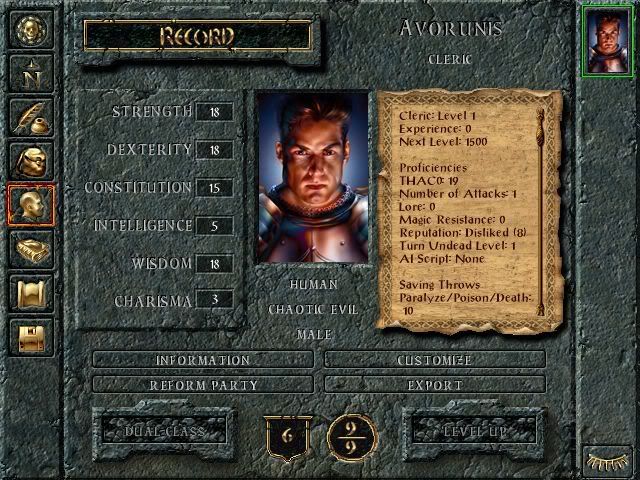
And spent the next week reading the manual and learning Second Edition D&D rules. Seriously. The game's manual was 200 pages long, and was more or less required reading. I loaded up the game the first day, and the character creation screen defeated me. An RPG where you weren't just dropped into the world as World-Saving Hedge Knight Boy! was inexplicable, and the depth to which BG expected you to customize your character spoke to the huge consequences those choice would have on your gameplay. I was supposed to make a whole character?!  Yes, outside of jRPGs, this is what "role-playing" is. But I didn't know that yet.

So I learned the rules as best I could before playing the game, created the character that best reflected me and my interests and abilities as I saw them (a cripplingly antisocial and uncoordinated human ranger with little strength or constitution who would ultimately see his way to the game's conclusion months later on the sole advantage of his enormous dexterity and a series of enchanted bows), and I was off.
Maybe if you'd hit "reroll" a few more times, God would have loved you harder, moron.
To really understand the depth of my amazement/horror/something, you sort of have to have a grasp of the differences between the typical jRPG and wRPG (or cRPG). Sorry to have mentioned that about thirty paragraphs too late. But yeah...the first thing that struck me about BG was the pace. I spent probably two hours doddering around the first town, clicking on drawers and stealing gold coins, enthusiastically taking up idiotic rats-in-the-basement (literally!) subquests, and reading the pages upon pages of text the game threw at you. A town that wasn't just an excuse for upgrading weapons and armor! Subquests! Even the novelty of just being turned loose in town and told to buy what was appropriate for your character before setting out on your journey was amazing. I had to look up what I'd chosen to specialize in and buy those weapons specifically to maximize my character's "attack roll", whatever the fuck that was. And yet, if I didn't, I would only learn of my mistake if I figured it out myself. There would be no huge talking winged pig-thing or fairy princess to hop in and tell me how to defend myself.
Though there would later be Minsc and Boo. Amazing.
This new approach (to me) to RPG-ing continued straight through the first (and sort of only) scripted event in the game, when you finally leave Candlekeep and your guardian is slaughtered before your eyes moments later, leaving you lost in the forest and alone. And I mean alone. There is really little to no indication where you should go next, or how to get there, and this resulted in a lot of trial-and-error as I got used to being brutally murdered by all kinds of forest creatures by attacking them in the least effective ways possible ("Oh look, a wolf! Let's punch it in the face!") and marveling at how few hit points everything had. But all the trial-and-error didn't bother me, because while I was learning how to play the game, I was also exploring. BG was the first game I'd ever played to really cut me loose in a world and let me "role-play" by essentially just saying "No, literally, you can do whatever you want". Everybody talks nowadays about how Mass Effect makes player choice count. Well, in BG there might not have been wildly divergent storylines in the same way there are in ME, but your choices counted. At one point, for example, I chose to defend a drow priestess against the two racist and straight-up assholish thieves I had met days earlier on the road (and befriended in desperation, using them for days after as basically wolf-shields for the characters I cared about), and as a result the thieves left my party, never to be seen again. Ostensibly I could have played all the way to the end of the game with those two, but I had to make a choice and thus the game (to me) was irrevocably altered. Just the feel of wandering in one of the game's many large, forested areas (in which you can meet NPCs that give you subquests, or wolves that try to eat you, or dungeons containing treasure, or just flat-out nothing) with the sound of a nearby brook burbling in your ears and who-knows-what around the next corner was intoxicating.
Hint: it's hobgoblins.
I played through the game once, them moved on to what many still believe to be Bioware's magnum opus, Baldur's Gate 2, stopping partway through to glut myself on the combat-heavy mayhem of Icewind Dale. A few years after polishing off these three games, I bought and played Icewind Dale 2, the swan song of Baldur's Gate's then-aged Infinity Engine and loved it. Yet I never really went back to those games again, for whatever reason. At first, the reason was Knights of the Old Republic, but once I'd played each of those twice I really had no excuse. Now, though, after spending two nights trying to pirate a decently-functional version of the original BG (I still own the game but after 12 years two of the discs don't read anymore), I'm back in the Larswood, using Montaron as a meat shield and happily picking off wolves with my compound long bow. It's amazing how riveting this game still is, dated graphics, somewhat horrid interface, and all. I suppose it speaks to the power of that original epiphany that I had...this must actually be one of those games, the ones that people like me will probably still be talking about a decade from now, one of the Citizen Kanes of PC gaming. I'm just glad that it still runs on my computer because it's pretty amazing. also, if you're interested, you can buy it DRM-free and for cheap on Good Old Games (gog.com). I'm off to slay things for a bit before bedtime, but I might have more thoughts as I progress through the game.

Mar 17, 2012

Review: Telepath RPG: Servants of God

Recently, a one-man operation called Sinister Design (aka Craig Stern) released the newest version of his turn-based Eastern-medieval-steampunk-turn-based-strategy-'em-up, Telepath RPG: Servants of God. As I may or may not have mentioned back on the ol' Tumblr, I played a ton of Stern's earlier games over this past Christmas break. I found them to be very addicting, but that addictiveness was almost entirely the result of the turn-based battle system that is the heart of all of his games (except for the mostly forgettable and blessedly short Telepath RPG Chapter 1). It's a pretty unique system that involves movement points, tile-based movement, slowly regenerating mana (it might not be called "mana", but magic points...you know what I mean) and a neat flanking/sideswiping mechanic that rewards you for thinking a few moves ahead. Basically, it's one of those beautifully-designed systems that is incredibly simple to learn, but that reveals more and more facets and details the longer you play. I liked this system so much that after playing the original (and free) Telepath Psy Arena and Telepath RPG: Chapter 2, I shelled out fifteen bucks for Telepath Psy Arena 2, which was even more fun than its free predecessors thanks to a refined version of the combat engine and the fact that it did away with everything but the battle sequences: essentially, it's a single-player ladder-type tournament game in which you just fight a series of harder and harder battles, using money from each victory to recruit new characters and buy new levels for them, which serves to unlock new abilities and power-up old ones. It was insanely addicting, and yet the fact that I was so pleased to see a version of the game that "trimmed the fat" of story and exploration, and all that (things that weren't, to my mind, implemented that well in Chapter 2) made me hesitate before shelling out for Servants of God (which is essentially Chapter 3). Would adding RPG elements like dialogue, towns, subquests, and narrative make this iteration of Telepath a "real" RPG? Or would it just distract from the battle system's greatness? More importantly, would this one-man project be worth the rather jaw-dropping asking price of $25? Well, I'm one "dungeon" away from finishing the game now, and I'm still just as unsure of the answers to these questions as I was before I bought the game.
You see the quotes around "dungeon" up there? That's the first problem. There are no dungeons or other RPG-esque crawly-explorey places in this game at all*. You enter each new area via clicking around on a Baldur's Gate-type overworld map, and once you've entered, say, "Bandit Cave", you are merely ferried through a series of battles until you face the boss battle. There isn't even a pretense of having you wander through corridors for a bit between battles; rather, it's literally just a series of what could just as well have been Psy Arena's battles provided with a bit of "story" context thanks to you clicking on a map.

*Full disclosure: there are dungeons in Servants of God. They are, however, "bonus" areas that don't need to be completed to finish the game. On top of that, they are so crushingly, shockingly complex and the puzzles that must be solved to pass through them so devilishly clever that unless you are willing to spend quite literally hours on each one or resort to an online walkthrough (like I did), you're just going to want to skip these dungeons and just play the main storyline, which is, again, more or less a series of battles that occasionally require you to click on a map to return to your base and listen to a talking head explain who the next bad guy is after you've won 4 or 5 of them.

Oh yes, that reminds me of the towns. The towns, such as they are, are weird affairs, in which you wander around with WASD and click on people randomly until someone actually says something that moves your quest forward. Again, here, there are a lot of optional quests at work. Unfortunately, a lot of them depend on your ability to navigate conversation trees to achieve a desired outcome, and often more conversation options become available to you as your character goes up in level. The problem is, often if you choose wrong in these conversations once, it slams the door shut on you ever being able to resolve that quest, even if you unlock further conversation options later on. Often, the only indication I even had that I'd screwed up a quest by choosing poorly was hours of play too late, while scanning random sections of the walkthrough. Nearly every one of these NPC-related subquests are activated by such random circumstances (and then completed, again, by even more random circumstances) that you can easily play through the game while talking to everyone once and not even realize the opportunity to begin most of these quests as its presented to you. I hate RPGs where every subquest starts with someone saying "Hey, I'm Norman! I have a basement full of mutated plague rats and I'm looking for someone to get rid of them..." as much as the next guy, but there's subtle and then there's too-subtle.

My last complaint: outside of all of the interesting (though ultimately too abstruse and easily-missed) optional content, this game could easily be finished in five hours, if not less. This five hours would almost certainly require a lot of grinding at the game's few grinding-caves (which are quite literally places that you click on the map to get thrown immediately into a battle, and when you win, and thus win gold that you can then use to level up your characters, you are forced to exit back out to the map and just click the same location again to start another battle) because without finding and then playing through all of the bonus content you're certainly not going to be leveled highly enough to take out the final boss.

Now, a few positives. I really, actually like this game (I bet you're surprised, yes?) in many ways. Especially considering this is a one-man project, the music is fantastic, the setting is unique, the story and accompanying dialogue is actually rather imaginative and well-written, the voice acting is miles beyond most voice acting in AAA games, and as I mentioned before, if you like turn-based strategy, the battle system is tops. With all of that going for it, I really hate to break things down to "too little for too much", but that's ultimately how I feel: for $25 bucks, I get much less play time and variety than I got in Telepath Psy Arena 2 for almost half that price, and what I do get is sort of weirdly half-formed and really requires cheating (via a walkthrough) to find and experience the best parts of the game.

It might well sound to you at this point like I'm saying that I dislike this game because I'm not smart enough to find the bonus content. As a veteran of many different types of RPGs and lots of video games and other puzzle-related media, you're just going to have to take my word that Servants of God is exceptionally dense when it comes to these things. For example, the bonus crypt-dungeons are fun despite being a complete departure from the rest of the game (why not require the player to explore a bit in, you know, the actual game?), and by the time you get to the final one, you're presented with a labyrinth that would require a gargantuan effort to map (you'd have to invest at least twice the time it takes to play through the whole game to do this). The reward that you receive for completing said labyrinth (which I did, again, by cheating) is so minuscule that it makes absolutely no sense, considering the time the player must have (in theory) invested. As another example, last  night I played a subquest in which you purchase a scorpion pet from a trader for 5000 gold (a rather hefty sum) so that you can give it to a child whose rabid scorpion pet you were forced to kill earlier in the game. Once you complete this transaction, you have the choice of going on your way with a sense of a job well done (the "good" option) or extorting the child's mother for compensation (the "asshole" option). If you choose the asshole option, you get an orb that boosts your player's personality stat by four points. As I mentioned before, you raise levels in this game by buying upgrades. Well, simply going to your headquarters and paying to boost your player's personality by four points actually costs far less than 5000 gold. You see the problem. Not only are most of these quests extremely abstruse, they're also often ultimately useless, or even leave you worse off than you would have been had you not engaged in them in the first place.

In the end, Telepath RPG: Servants of God presents what is by far the best iteration of the series' excellent battle system, and in a way, as a fan of that battle system, it was worth paying to have the newest version of that system with the few tweaks that have been introduced since Psy Arena 2's release. However, the faults with the rest of the game made me wish that I'd just been given another ladder-type tournament game rather than an "RPG", the shortness of the main game makes it a bit of a rip-off for $25, and the combination of the sidequests' totally bizarre implementation and the fact that they are often the most interesting parts of the game is just frustrating. If you haven't played any of Sinister Design's games, definitely check out Psy Arena 2. If you like it as much as you probably will, you might want to throw some more money at Servants of God. But unless you've got a bigger games budget than I do, I wouldn't recommend it.

Mar 7, 2012

game over? (part two)

Well, I'm just getting to the second part of last week's post now because I fell disgustingly, cripplingly ill this weekend and there were more important things to deal with (snot, mucus, fever) than adding another molehill-based mountain to the topography of Blogland.

Also, I'm capitalizing correctly now. I hope that's okay with everyone. I'm all growed up!

So. This should be briefer than the previous piece, but I wanted to ruminate a bit more on the whole alpha buy-in phenomenon; more specifically, how that phenomenon functions (successfully and not) in particular game genres.

As I see it, buying into an alpha- or beta-stage game and then playing the game as it is developed (as I've done with Minecraft, Desktop Dungeons, Mysterious Castles, and a few more games that I'm totally blanking on right now) has its advantages, for sure. But it also compounds a problem that currently seems to be sweeping the gaming world in a variety of guises at the moment: nobody knows where a particular game starts or (more importantly) where it ends anymore. Whether it's a game like Minecraft that had no "end", per se, in the first place (until popular outcry led to one being slapped on, against the game's sandbox ethos), multiple recent AAA games whose "stories" are extended ad nauseum thanks to excessive, expensive DLC, games that are released over 3-4 different platforms with significant differences (or "bonuses") in each edition that require, in theory, the player to own all versions in order to get the "full" experience, or games like the recent Mass Effect 3, which more-or-less requires the player to play multiple types of games across multiple platforms in order to get the "correct" ending at the conclusion of the "main" game...games just don't end like they used to. I mean, imagine beating Bowser in World 8-4 in the original Super Mario Bros. and seeing "Sorry Mario, but our Princess is in another castle...and you'll have to pay $20 more to access the final level to save her!" Pretty disheartening. Really, though, SMB is a bad example: it's primarily a ludus-driven game; if you paid the twenty bucks in my hypothetical scenario, odds are you'd be playing it primarily to unlock more levels, to play more, not to find out the conclusion to the enthralling Super Mario Bros. saga. So another, perhaps better example: Sephiroth kills Aeris right in front of you, and you chase him across the world in search of revenge. After finally tracking him to the frozen north, you defeat his first form, leading to that quintessential jRPG moment: "NOW I SHALL UNLEASH MY TRUE FOOOOOOORM!!!" Then the game politely informs you that to face the "final" version of Sephiroth, you first have to purchase, download, and complete Final Fantasy 7: Tetris Attack!, the new puzzle-based, block-stacking game for your PSP.

Okay, that example's a little farfetched. But you get the idea. It used to be that you bought a game, pulled a physical cartridge or disc out of a package, played the self-contained game inside, and when you reached the end, it was the end. Digital distribution and always-online gaming has brought its share of positives, for sure (and a lot of other negatives that there's no room for here), but it's really begun to muddy what "the end" really is, even in games that have discreet ends. Take, for example, The Binding of Isaac, a game I've really enjoyed playing since it came out and have blogged about previously. It has a discreet end: you fight your way through all the levels, and you beat the final boss, and you're done. However, twice now, the developer has created updates to the game (free updates, mind you) that add more levels to the game, thus making the game a different experience than it once was, and rendering the completion of the original game void in a way. If you finished the "old" version of the game, you sort of missed out, compared to how the game is now. So if you want the "full" experience, you have to go back and play again. And then again, when the next update comes out.

You've probably picked this up at some point, but I'm pretty busy. I work a lot, and I don't have a lot of time to play games (unless that playing is, too, for work). So while I liked The Binding of Isaac, once I'd finished it a few times and got a good sense of how it was to play through the game with a few different Isaacs, I stopped and moved on to one of the other games on my ten-mile-long list of games I still need to play. When the update came out, I went back and played to the end again. It was fun, but I felt a bit harried, having already thought I'd experienced all the game had to offer. When the next update came out, the game had not only gotten twice as long as it had been originally by that point, the last two levels were brutally difficult. I tried to get through them a few times, found that I really couldn't do it very easily, and decided that getting good enough to finish the new version of the game wasn't worth my time. So I didn't play anymore...and now, in my mind, Isaac has gone from being a really fun game I picked up and enjoyed for a few weekends to a game that takes too long to play, gets too difficult at the end, and that I've never finished: an ultimately unsatisfying experience. Weird, huh? But that's how my brain works.

Things get even more complex when there's a "story" involved. When players not only enjoy the game mechanics but identify with one of the characters or get wrapped up in those characters' struggle to succeed (as happens in games like Mass Effect, for example), they not only have an entertainment-value investment in the game, but an emotional one. It's important, I think, to either give gamers who've made these connections a sense of closure at some reasonably-easily-attained point. Giving someone a few extra levels of Super Mario Bros. is not the same as showing them the "conclusion" of a massive, multi-part space opera that they have a personal stake in due to the dozens of hours they've invested playing a character that they've designed and then a month later saying "Just kidding! You want to find out what happened next?!" This is novel to a degree, but at some point it just gets exhausting. It's the video game equivalent of that TV show you used to love, but which ran about four seasons too long and now you've stopped watching. Video games have developed the ability to run their franchises into the ground, I guess.

Anyway, my original point got a bit away from me, and I have to go, but...genres. I think adding new content to a game like Minecraft or Terraria indefinitely is totally reasonable. It's a sandbox: adding more tools is always going to be fun. Players don't come for the conclusion, they come to play. Doing the same thing with a game that's primary draw is the story-within-a-story of the player's character(s) struggling through whatever it is that they're struggling through (as seen in Final Fantasy 7, Mass Effect, etc.) is different. Some games function on this meta-narrative level and some don't. Designers have to know which kind of game that they're developing, and I feel like if you fall into the former camp, that demands some awareness of how you're allowing your players to engage with that meta-narrative...and doling it out to them in chunks is just awkward and dispiriting, whether you're doing it to make five more bucks on DLC or if you're just upgrading as you go.

I feel like I lost my thread a bit there...oh well. Good time to start diss writing!

Mar 1, 2012

game over? (part one)

so, i'm just going to keep writing about video games, apparently, because that's all i think about anymore. and not even in a fun way, but in a pretentious, overly-analytical scholarly way. like, i can't even play vvvvvv anymore without thinking "why is the female stick figure pink and not some other, more gender-democratic color?" studying cultural and critical theory has already ruined books and films for me. if it ruins video games as well, i'm pretty sure that this world will quickly become one that i no longer want to live in.

but i digress (can one digress before actually stating their main point?).

today i want to talk about public alpha builds and how everyone and their dog is releasing unfinished games nowadays. hell, there are even alpha-themed indie bundles and people paying up to 2 million dollars for a game that hasn't even been made yet. generally, this is pretty awesome: it's another new way that the internet is allowing people to get money directly into the hands of their favorite indie developers and really democratize the game-making process. ideas that would traditionally have needed a publisher (and wouldn't have gotten one on account of being too interesting and weird) can now be designed using fans' money and then distributed for free to collect more fans' money, which goes into the creation of the next big indie thing. it's great.
brought to you by typing "dog made of money" into GIS. you're welcome.
the primary example of this, of course, has been minecraft. i actually got in on the ground floor of minecraft (a few days before the first beta) thanks in large part to my rock, paper, shotgun obsession. and not only was it great to get an excellent game for super-cheap, and great to be able to play said game months and months before it became mega-internet-popular, let alone before it was properly "released" in late 2011, it was a really thrilling process to be able to watch the game develop from inside the game.

there's nothing like buying a game, becoming enamored with its world, and then realizing that for regular intervals over an indeterminate amount of time you're going to get new content and more awesome things added to that world for absolutely free. not only that, you can often make suggestions to the developer and then see your own suggestions manifest in a later build. getting into the minecraft alpha was my first experience with this whole process, and i've bought a number of games in alpha or beta since and gotten to watch them grow, often in good ways and sometimes in bad ways. yet, even when a game develops contrary to what i myself would want, it's generally been a 1-5 dollar purchase, so it's a bit hard to get upset. most people blow more than that on coffee a day, and coffee always does the same thing to me:
what i'm interested in at the moment, though, is not actually what happens during the time that a public alpha game's development cycle is made available to the public for appreciation and scrutiny. instead, i'm interested in what happens when that development cycle ends (often under the opposite of appreciation and much more scrutiny).

take as a sort-of example the recent "completion" of terraria, a minecraft-esque 2d platforming game. the game's original release occurred in may of 2011, and was labeled "version 1.0" indicating that the game was more of less meant to be complete as it was. it sold 50,000 copies in its first day, a fairly amazing feat for a game made by two people and largely marketed through word-of-mouth, and buyers were informed that they would receive all future updates from of charge, but (much like public-alpha games) those buyers were not told how many updates there might be, what those updates might contain, etc. essentially they paid for a project that was still in development.

excellently, the developers delivered an absolute fucking ton of new post-release content, all free, for nearly nine months. then, recently, they announced that the game (which had been expanded far beyond its original scope) would no longer be receiving updates. in a move perhaps unsurprising for the internet generation (but still depressing), this news (that the enormously engaging and excellent game that they'd paid 10 bucks for and then been allowed to get substantively new versions of  for free every few weeks for almost a year) drove the terraria community into a frenzy of name-calling, death threats, and other such bizarre, ugly nonsense. the gist of the response was that terraria shouldn't have been "allowed" to end when there were still so many things that the community wanted to see implemented. and herein lay the dark side of letting your customers buy into your game before you're finished: they seem to lose the ability to understand that you can be finished. technically speaking, terraria was finished when version 1.0 was released. the rest was, as they say, just gravy. to see negative fan response to the degree that resulted from terraria's "ending" is bizarre and disheartening, and i think it speaks to the sense of entitlement that letting your community in on the ground floor of the development process can breed. plus, maybe most terraria players are whiny, entitled jerks (which seems to be the case). hilariously (to me), many players in fact have insisted that they will no longer play the game if it won't receive new updates. not too many years ago (two, actually) you just went to the store and bought a game, and that game is what you got. terraria's fanbase might be a huge pile of asshole-faces, but that doesn't eliminate the fact that between games with 900 dollars' worth of DLC and games that imply a future of infinite content updates for the buyer, people have gotten a little confused as to what exactly they're entitled to for the money that they pay.
terraria players: "this. we're entitled to this."
on the other hand, there also seems to be a potential problem with developers deciding when their game is finished. again, let's return to minecraft. it's official "release", version 1.0, occurred in november of last year. since then, the game continues to get updates, but markus persson, the game's creator, has long since stepped away to work on other projects, leaving minecraft in the hands of a few of his subordinate designers. recently, each new update is simply met with more scorn from the community, who seems to simply want the game to be "done".

is alpha buy-in the next big thing for gaming? or is it just a more seductive manifestation of caveat emptor?
.
.
.
.
.
.
.
.
.
i don't have an answer, if you were waiting for one. i do want to write a bit about how the effectiveness of the alpha buy-in idea is affected by individual games' genres, but i think that's a discussion for tomorrow, because i need to get back to work.