This post was originally published in Recomposing the Pines on 4/1/14:
I've taught a few variations now on a class that I'm currently calling "Digital Diversity." It's a class that I really enjoy teaching, and that focuses on a topic very close to my heart: discussing all of the insidious and wonderful little ways that our day-to-day lives are tied seemingly inextricably to the internet and computing technology nowadays.
Though most of my classes get a better reception the more times I teach them (which I like to think indicates my ability to adjust and improve according to feedback and more pedagogical reflection) or at the very least balance out at a pretty acceptable level of success, Digital Diversity has been pretty distinctly and obviously less successful each time I've taught it. I've been trying to figure out why for a long time, in the process pouring a lot of thought and extra work into solving the problem (including writing a few more blog posts about it, which are currently sitting at the top of my "Drafts" folder), and I haven't come to any solid conclusions or discovered any obvious solutions yet. However, stumbling across an old email this morning might have helped me understand what's going on a little bit better.
The email in question was from an old colleague of mine and it popped up in gmail as one of the results of a totally unrelated search, a weird quirk in the search algorithm. It was a reminder about a project said colleague was working on as part of a class we were taking together. The colleague was interested in studying Twitter, and so, for one particular week of the seminar, she was requesting that we all install the Twitter app on our phones, enable all notifications, and then be prepared to discuss the experience of being "always-on" through the app when class reconvened.
That's it. Today, a discussion about how annoying Twitter notifications are is like a discussion about how annoying it is when the weather calls for sun and it starts raining. Everyone gets it. It's hardly a topic that needs the environment of a graduate-level seminar in cultural studies to happen. But I distinctly remember being extremely interested in the topic from an academic standpoint when this seminar was going on. I remember my colleagues and the professor being extremely interested. And I remember the discussion being engaging and enlightening. That seminar took place maybe six years ago. In the last six years, social networking over the internet has become so tightly integrated into most of our lives that to speak of it analytically, critically, is, for want of a better word, passé.
I was a graduate student in an environment in which talking about the politics of identity creation on Facebook, on Twitter, and so on, was a burgeoning topic of interest and (apparently) intense importance, at least in the discourses of cultural and media studies. And I was learning about these subjects through research and dissertation work as they were being spoken about and written about in that same way. And I was learning to teach about these subjects as they were being spoken about and written about in that same way.
Flashforward to six years later, and it's beginning to feel like my pedagogical approach is flawed. I learned (in part) how to teach while working under the assumption that these technologies and our applications of them were exceptional and that they should be presented, discussed, and deconstructed as such. In 2014, there is nothing more reflexive (or at least, so it seems) to college-age students than using Facebook and Twitter as one of their main ways (if not their primary way) of interacting with the world outside themselves socioculturally. In my class, when I want them to think about whether or not Facebook's interface inherently and importantly limits their ability to express themselves to their friends in ways that might not exist in face-to-face conversation or conversation over the telephone, they are bored.
This is, of course, nobody's fault, but I'm not sure how to overcome the difficulty nonetheless. Every time I change the course, I update readings, I change assignments, I alter notes, I approach subjects from different angles. On a day-to-day basis I read at least 2-3 articles regarding technology use and its effects on our culture, not just to "stay current" but because it's what I'm interested in as a person, not just as a teacher. It's not as if I'm coming to class with anecdotes about Friendster and screenshots of my old GeoCities page (don't try to find it; you can't). But I wonder if there's a chronological or maybe even generational gap that's effecting my pedagogy here: to me, even fifty years from now, a lot of these technologies and our applications of them will always be a) fascinating and b) worthy of critique, because I remember what it was like when they first came into being, how dramatically things changed. It's possible that all the research, revision, and pedagogy workshops in the world aren't going to be able to close that gap between me and students who take classes like Digital Diversity.
Thoughts?
May 29, 2014

So, Getting Used To Working At A Teaching School Is Weird, But Good.
This post was originally published in Recomposing the Pines on 11/21/13:
I want to start this post by mentioning some things that I like. I'm going to do this because after that, I'm going to talk about how I don't like some of them as much as I like others, or, at least, how some have become more important to me than others, their value more obvious, and I don't want to give the impression that I dislike the less-liked things...I just like them less than maybe I once did.
When I switched my undergraduate major from Computer Science to English Literature way back in 2001 (or maybe 2002), I did it because over the first 2.5 or so years of college, I'd realized that I fundamentally, absolutely loved the lifestyle higher education allowed me to have. I was perfectly happy working 12 hours a day if that work was reading, learning, questioning, writing, exploring, and if that time was spent with and around others who also valued those activities. I was happy enough with this lifestyle and wanted to live it badly enough to give up a major that would have easily (in the early 2000s) landed me a job right out of college that would have paid significantly more from the onset than my current tenure track job will ever pay even at the full Professor level.*
My enthusiasm for this lifestyle has waxed rather than waned over the years. It's become less and less financially practical to actually make a living by working in higher education as an actual educator (it's another story if you want to be an administrator), but that continues to not really matter much to me. I still love writing, I still love reading. During my time at WSU, where I was required to teach courses while pursuing my graduate degrees in order to receive funding, I even discovered that I actually really like teaching, something I would never have imagined about myself back in the KSU days, when I was just desperately looking for an excuse to stay enmeshed in the intellectual environment of a large public university after getting my bachelor's degree. That said, some of my favorite memories of my graduate career involve participating in great seminar discussions after wading through hundreds of pages of theory, and condensing that theory and tweaking it to plot and write up a dissertation that I thoroughly enjoyed and am (mostly) proud of. So, by the time I received my Ph.D, I had, usefully, realized that I loved both teaching and researching.
Interestingly, my new job wants me to do one of these and not the other. It's 2013, so I'm pretty sure you can guess which is which.
When I first learned this, during a post-interview phone call with my then-potential employer, my heart sank a little. Taking a job where I taught a heavy course load and wasn't expected to engage in research (read: "We won't give you time or money to do any research"), seemed utterly depressing to me. I loved the research I was doing, and couldn't imagine giving it up to "just" teach more classes.
Well, as you can probably guess, this is the part where I decide that I don't like some things as much as others: flash forward about seven months, and I feel completely different about the whole teaching vs. research thing. I realize that my opinion isn't for everybody, and I'm not writing it here to force it on anyone else, but just to share my own experience. So.
Working at a teaching-oriented university is awesome.
See, the always-underlying issue I had with the work I was doing before was that it was pulling me in two opposing directions basically constantly. I love teaching and I love doing research, but when you're doing both at the same time, you're always doing both to about half of your ability. Or, at least that's how I've always felt. When I was able to just sit and read and write for a week, I was able to create some of my best-ever work. When I was able to just focus on lesson planning and teaching for a week, I was able to teach some of my best-ever classes. Out of eight years of work at WSU, how many times did I get these "one-only" opportunities? Maybe 2-3 times apiece. That's not an indictment of any particular person or department or policy, just an observation of how the general expectations that come down from on high at a huge public research university force you to mix, mingle, and often ultimately shortchange your priorities.
Here, it's easy: I work on teaching all the time, except for when there's a committee meeting or another service-related opportunity, and then I put the teaching aside for an hour and focus on that. The transition back is much easier, because helping to guide the course of a small department has a lot in common with teaching (and learning). Research, though it can certainly inform one's teaching, doesn't have a lot in common with pedagogy itself. Unless, I suppose, you are researching pedagogy. Which I was not.
So, practically speaking, my job's not nearly as confusing. I'm switching gears much less often, and though I work just as hard and often get just as tired, I'm not burdened with that feeling of being stretched too thin, of knowing I could teach better if I didn't have to attend my fourth conference of the year or knowing that I could really knock this article out of the park if I didn't have to teach three classes this semester, and so on.
Existentially, focusing just on teaching is a lot nicer, too. This is what's really surprised me, and what's possibly going to piss off some of the gentle readers out there. Surprisingly, "service" is no longer a bad word to me. Once, it was that pesky thing that you half-assed on your CV, the grad student equivalent of putting Who's Who Of American High School Students on your college application. Now, it's things that I do naturally every day as a result of being part of a small department, in a small town, with a recognizable and manageable community of students and faculty and administrators.
Because this is such a small school and the only thing that's more important on faculty evaluations than "service" is teaching, there's (generally speaking, at least) a positive attitude toward university- and department-related activities built into the way most people approach their work here. And this is great for me. Since I started in September, I've already made progress on helping to introduce a new academic program to the school, created six new courses that should all be seeing the light of day over the next 2 years or so, made inroads toward getting placed on two faculty committees whose work I think of as very important to the university and community at large, and met informally with a large number of faculty members to discuss how we can improve our Humanities offerings to more directly suit their programs' needs. I have a lot more time to meet with students individually, I've talked to every member of my department at length, both about work and more mundane things, and I'm setting up one-on-one, face-to-face meetings with the Provost and President of the university to discuss my thoughts on revamping the Humanities offerings and general education requirements.
I don't list all of those things to brag, but to make the points that a) I'm doing lots of things that are going to (hopefully) be directly valuable to the university and its student population and b) all of these things are way more meaningful to me than getting another article published in some obscure journal after months of toiling away alone in my office.
I once read an article (and I really wish I could remember where, because it would help this post out a lot) that suggested, pretty compellingly, that requirements for "research" in the humanities was something colleges and universities just sort of started requiring middle-level faculty to engage in before they could qualify for tenure for the sole reason that there wasn't much else for them to do besides teach classes. In larger universities, departments got so big that there was really no meaningful way to include all faculty in the processes of governance and upper-level decision-making, so they were, essentially, given something else to do instead to hide the fact that the system had become too cumbersome to care about their input anymore. Now, I don't know how accurate that is (like I said, the article was pretty convincing, but I also didn't follow up by investigating its claims in detail or anything), but it rings fairly true based on my own experience.
Like I said at the onset, I love doing research and writing articles, and writing my dissertation is one of the most rewarding things I've ever done academically. But it's hard to regularly put so much time and effort into publications that are likely to only be read by a few people who are already hanging out in the same echo chamber as you, especially when the time spent writing could be applied to teaching or to working to make a positive change in your immediate department or university. Research is great, but if given the choice between working on an essay of mine for an hour or serving on a committee that's working toward a positive infrastructural change at my university for an hour, I'll always choose the latter. It's more immediate, and to me, more ultimately meaningful.
Certainly, when you write to publish, you're learning a lot about your field and then you're "creating new knowledge." But I can still do that by reading a bunch of books before choosing one for a class (which I do every semester) and then discussing that text in class, requiring my students (and thus myself) to critically think about the material in it for a couple of weeks. I can blog, tweet, talk to my colleagues, and engage in other forms of meaning-making based off of the things I'm reading and the concepts I'm pondering, all without having to resort to the draconian and ultimately somewhat hollow experience of hurling myself into the maw of academic publishing again and again. I haven't written any new article material yet this year and I don't really plan to, but I don't feel dumber as a result. I feel both smarter and more like my energies and talents are being applied to tasks that have a more immediate benefit both for me and for the rest of the university.
Of course, I don't mean this as a condemnation of humanities research or anything dramatic like that; it's just that it's been striking to me to realize how much more focused and simultaneously more relevant and productive I feel without having to worry about it as much anymore. I've been surprised at how hollow it seems (again, just to me) now that I have an actually well-defined and relatively powerful role to play in a small department that's excited about my input in a way that a larger department just couldn't be. It's a combination of factors that obviously isn't available to everyone who is in this line of work, and even if it was, I imagine a lot of people wouldn't want it. But it's working out really well for me by allowing me to stop focusing on the things that I've been told Matter Greatly and focus instead on things that matter to me intrinsically.
* At least two friends of mine who majored in CS around this time immediately started jobs with six-figure salaries after receiving their B.S.
Mar 31, 2014
Garfield and Applegate Peaks in the Snow
So Monday of last week was the only day of my Spring Break that was going to have half-decent weather. "Fortuitously," I also really only had time to take one day off. I had plans to try one of a few pretty serious mountain snow climbs that day, but it had snowed at or near Klamath Falls elevation each of the three previous nights, and so I was pretty strongly doubting my ability to actually drive to any trailheads deep in the woods. So instead I decided to go to Crater Lake and snowshoe/climb. Again.
I say that like it's a bad thing.
Having snowshoed about as far as I reasonably could snowshoe in one day around the West Rim Road and climbed all the peaks on that side within my range, I figured this time I would take the East Rim Road, and revisit an old friend (Garfield Peak) while trying to make a new one (Applegate Peak).
The drive up to Park HQ this time was amazing. Despite the dusting of snow we'd had the night before, the road was completely dry by 930am or so, and it was by far the safest-feeling drive I've had to HQ since winter started. Though there were definitely clouds, the sun was out, and warm enough that I was able to drive in basically just my base layer without the heat on in the car.
One immediate upside to hiking the East Rim Road is that you don't have to drive the final four windy miles of road up to Rim Village - in winter the East Rim Road begins right across the street from HQ.
My plan was to hike approximately 1.5 miles along the road until, according to random guy on a random website, I would be able to see Applegate Peak in the distance. Then I would cut off the trail and head due north to the summit through a huge snowfield. Remembering the fun times I had tromping around the bases of Tipsoo Peak and Howlock Mountain late last fall, I was especially excited for the snowfield.
Well, I can vouch for the fact that the first 1.5 miles of the East Rim Road in winter are not nearly as cool as the first 1.5 miles of the West Rim Road. The lake itself is nowhere to be seen (in fact, I wouldn't see it until I was very near the summit of Applegate, a few hours later), and the road is basically just a slightly uphill, straight line through some very same-looking trees. Very rarely am I on a hike anywhere outside that I would describe as mind-numbing, but this was a little bit that.
After I'd covered about a mile, I busted out the GPS and started scanning for the location of this mysterious snowfield. So far all I'd seen was thick pine forest on both sides of me with no openings in sight. The topo map reinforced what I was seeing: there was no sign of any opening/snowfield anywhere up ahead. Already a little beat from snowshoeing on too-powdery snow, I was getting a little annoyed. I could certainly bushwhack to the north, but from what I could tell I'd be heading through some thick trees up a really steep incline, which was not my idea of fun. Otherwise, I'd have to give up the summits entirely and just try to enjoy a hike along the Rim Road for a few more miles. Or just go home.
I continued on for another half mile or so, trying to decide what to do before finally taking my chances with the forest. I watched the GPS until what looked like the thinnest part of the forest was directly north of me, then put the thing away, took a bearing on my compass, and headed uphill. I was almost immediately rewarded when, after about five minutes (if that) of walking, I burst out of the trees into the promised snowfield. A few minutes after that, Applegate and Garfield loomed into sight in front of me.
Thus began the rest of the day's ridiculous gear-switching and self-doubting adventure.
First, I strapped my snowshoes and poles to my bag and switched over to descending the mountain in just boots and an ice ax. I had crampons in my bag just in case but they didn't seem necessary. This worked great, as I sunk down into the powdery snow but just plowed through it with my downhill momentum. Eventually I struck the ridge that joined Applegate and Garfield and headed toward my next target.
At this point it really started to hit me, though, that I hadn't eaten or drank much all day. For a bit, I just considered calling it a day and heading home, especially since I'd already summited the only new peak I had planned for the day. But Garfield looming ahead egged me on and I quickly dropped down into a little snow-cradle along the lake's rim and scarfed lunch #1.
Shortly thereafter, I found myself grinding up Garfield Peak. This time, faced with a short-but-dirty route and a safe-but-long route, I forced myself to hike out around to the west a bit and latch on to the less inclined part of the ridge...maybe I can be taught!
Whether it was the sun, the powder snow, or something else, by this point I was absolutely beat. We're talking seriously lay-down-and-take-a-nap-right-there tired, the way I've only ever been before on a few of my longest hikes (and my first half marathon). But since any nap would involve a bed made entirely of fucking snow, I stopped to catch my breath, strapped my snowshoes and poles back on again, and headed the rest of the way up.
The summit of Garfield is also very flat, but there's a lot of space to move around, and so I spent a fair amount of time up there, taking pictures and forcing the camera to take pictures of me...
...before finally finding a low, tree-enclosed spot to eat the rest of my food in and just be out of the howling wind for a few minutes. I should clarify, I guess, that the wind was only about 20-25mph, tops, but it was so insistent that after a few hours it was starting to drive me nuts. Huddling in the middle of a little stand of trees at the summit restored my sanity somewhat.
From there, I switched back to my ice ax and boots combination to glissade (in a few 100 foot sections) down the face of the mountain and then used my compass to guess how to most efficiently descend back to the Rim Road without having to unnecessarily retrace my steps.
It seemed, at first, that I had guessed wrong. After tromping downhill to the south for about twenty minutes, I ran out of room to walk, but could see the maintenance sheds near Park HQ right below me (okay, about 600 feet below me). There seemed to be some decent glissading runs here, and I very nearly cliffed myself out through sheer stupidity before remembering what had happened to me and Dale on Trapper Peak and forcing myself to just follow the cliffline until it started to descend toward the road in a more sane manner. I got in a few more decent glissades while doing this, until I started hearing an under-snow stream somewhere nearby and started choosing my steps more carefully as a result, but eventually I emerged onto the road, only .42 miles from the parking lot. I'd actually managed to shave almost a mile off my walking distance.
I was happy but also zapped, so I sat in the shade on the Rim Road, directly in the damn snow, and ate the rest of my food...then continued to just sit for about another 20 minutes, until the idea of walking that last .42 miles became palatable to me. Then it was back up the super-boring stretch of road to the car.
All in all, it was a great hike for the views, the snowfield, and the moderate routefinding challenge. It ended up being a little harder than I expected, but I think I'm still bad at estimate the effort involved in a snowshoe mile versus a "normal" walking mile.
I say that like it's a bad thing.
 |
| It's not. |
The drive up to Park HQ this time was amazing. Despite the dusting of snow we'd had the night before, the road was completely dry by 930am or so, and it was by far the safest-feeling drive I've had to HQ since winter started. Though there were definitely clouds, the sun was out, and warm enough that I was able to drive in basically just my base layer without the heat on in the car.
One immediate upside to hiking the East Rim Road is that you don't have to drive the final four windy miles of road up to Rim Village - in winter the East Rim Road begins right across the street from HQ.
 |
| Right here, actually. |
Well, I can vouch for the fact that the first 1.5 miles of the East Rim Road in winter are not nearly as cool as the first 1.5 miles of the West Rim Road. The lake itself is nowhere to be seen (in fact, I wouldn't see it until I was very near the summit of Applegate, a few hours later), and the road is basically just a slightly uphill, straight line through some very same-looking trees. Very rarely am I on a hike anywhere outside that I would describe as mind-numbing, but this was a little bit that.
After I'd covered about a mile, I busted out the GPS and started scanning for the location of this mysterious snowfield. So far all I'd seen was thick pine forest on both sides of me with no openings in sight. The topo map reinforced what I was seeing: there was no sign of any opening/snowfield anywhere up ahead. Already a little beat from snowshoeing on too-powdery snow, I was getting a little annoyed. I could certainly bushwhack to the north, but from what I could tell I'd be heading through some thick trees up a really steep incline, which was not my idea of fun. Otherwise, I'd have to give up the summits entirely and just try to enjoy a hike along the Rim Road for a few more miles. Or just go home.
I continued on for another half mile or so, trying to decide what to do before finally taking my chances with the forest. I watched the GPS until what looked like the thinnest part of the forest was directly north of me, then put the thing away, took a bearing on my compass, and headed uphill. I was almost immediately rewarded when, after about five minutes (if that) of walking, I burst out of the trees into the promised snowfield. A few minutes after that, Applegate and Garfield loomed into sight in front of me.
 |
| The snowfield. |
 |
| Garfield Peak. |
 |
| Applegate Peak. |
I spent an inordinate amount of time trying to figure out which peak to visit first and whether or not I should conceive of some convoluted route that would allow me to cache extra gear midway between the summits and reclaim it at some point before just deciding to tough it out with a full pack. After all, how tough could these two small summits be?
Pretty damn, as it turned out. The hike across the snowfield was maybe the best part of the day. It was almost entirely beautifully pristine, sun-sparkled snow except for a single other set of snowshoe tracks and one set of ski tracks, the kind of snow you feel bad about walking on. The mountains got more and more haughty-looking as I moved toward them, and as Vidae Ridge dropped away below me, it revealed McLoughlin, Union Peak, and the other mountains that ranged to the south. The sun was a bit too hot and I wasn't drinking nearly enough water, but I didn't think much of it until I was at the foot of Applegate. There, I had the choice to either go right and try to wend up to the summit in between a series of sharp, rocky cliffs that protruded out of the snow, or to go left, a bit further out of my way, and ascend an easy ridge to the top. Because I never learn anything and am dumb, I tried going right. This got really hard really quickly and soon after that it became obvious that there was no way up the mountain between the cliff faces, unless I wanted to risk falling a thousand feet into Crater Lake. So I got to spend about forty-five minutes traversing across the south face of the mountain on powdery snow in snowshoes. Twice I feel completely on my face, soaking my clothes. It was gross, and dumb.
But eventually there was a break in the rock wall above me and I heaved myself up to what passed for the summit. By this point, the wind was howling (and the snow - underfoot, at least - was outrageous) so I didn't spend much time up there other than to touch one snowshoe tread onto the summit platform, which was about the size of one man laying down with a thousand foot drop on the other side of it and very well might have been the top of a cornice.
 |
| The view back down the hill from the cornice deathtrap. |
First, I strapped my snowshoes and poles to my bag and switched over to descending the mountain in just boots and an ice ax. I had crampons in my bag just in case but they didn't seem necessary. This worked great, as I sunk down into the powdery snow but just plowed through it with my downhill momentum. Eventually I struck the ridge that joined Applegate and Garfield and headed toward my next target.
 |
| Garfield Peak |
 |
| Dyer's Rock |
Shortly thereafter, I found myself grinding up Garfield Peak. This time, faced with a short-but-dirty route and a safe-but-long route, I forced myself to hike out around to the west a bit and latch on to the less inclined part of the ridge...maybe I can be taught!
Whether it was the sun, the powder snow, or something else, by this point I was absolutely beat. We're talking seriously lay-down-and-take-a-nap-right-there tired, the way I've only ever been before on a few of my longest hikes (and my first half marathon). But since any nap would involve a bed made entirely of fucking snow, I stopped to catch my breath, strapped my snowshoes and poles back on again, and headed the rest of the way up.
The summit of Garfield is also very flat, but there's a lot of space to move around, and so I spent a fair amount of time up there, taking pictures and forcing the camera to take pictures of me...
 |
| Like this. |
From there, I switched back to my ice ax and boots combination to glissade (in a few 100 foot sections) down the face of the mountain and then used my compass to guess how to most efficiently descend back to the Rim Road without having to unnecessarily retrace my steps.
It seemed, at first, that I had guessed wrong. After tromping downhill to the south for about twenty minutes, I ran out of room to walk, but could see the maintenance sheds near Park HQ right below me (okay, about 600 feet below me). There seemed to be some decent glissading runs here, and I very nearly cliffed myself out through sheer stupidity before remembering what had happened to me and Dale on Trapper Peak and forcing myself to just follow the cliffline until it started to descend toward the road in a more sane manner. I got in a few more decent glissades while doing this, until I started hearing an under-snow stream somewhere nearby and started choosing my steps more carefully as a result, but eventually I emerged onto the road, only .42 miles from the parking lot. I'd actually managed to shave almost a mile off my walking distance.
I was happy but also zapped, so I sat in the shade on the Rim Road, directly in the damn snow, and ate the rest of my food...then continued to just sit for about another 20 minutes, until the idea of walking that last .42 miles became palatable to me. Then it was back up the super-boring stretch of road to the car.
All in all, it was a great hike for the views, the snowfield, and the moderate routefinding challenge. It ended up being a little harder than I expected, but I think I'm still bad at estimate the effort involved in a snowshoe mile versus a "normal" walking mile.
 |
| It did not snow on the way back down, but Google added this to my account automatically and it sort of freaks me out. So have it. |
Mar 28, 2014
Dual-Summit Weekend: Hogsback and Black Butte
A few of my favorite weekends as a citizen of Klamath Falls thus far have been what I've taken to calling "dual-summit weekends." Basically, it involves climbing one mountain on Saturday and one on Sunday, ideally in different places so that there's lots of driving and enjoying the surrounding countryside (and maybe restaurants) in the process. This is a novelty to me, I think, because when I lived in Pullman there just weren't any high points close enough to make such a thing possible. If you wanted to climb more than one mountain in a weekend, they had to be along the same trail and you had to fucking bust ass to get them done and finish the 4-5 hour (or much more) drive back to town before school started again on Monday morning.
Here, there are so many amazing high points within 45 minutes or so that I don't have that problem. Hence, dual-summit weekends. I did a few last fall before the snow started falling in earnest: the first one was Yamsay Mountain and then Mount McLoughlin, and the second was Mount Bailey and Howlock Mountain (by way of Tipsoo Peak, so I guess that counts as three). A few weekends ago, Lindsey and I decided to get a bit carried away in the name of rare sunny March weather and attack a few "peaks": Hogsback (in Klamath Falls) and Black Butte in northern California.
I put "peaks" in quotation marks there to indicate that Hogsback, at least, wouldn't really be considered a legitimate summit by anyone who climbs mountains seriously...but damn if it isn't a 1,800 foot ascent from town, so I'm counting it.
We headed across town on Saturday morning to the parking lot of a random church that I'd noticed was next to a trail that was visible on Google Maps and labelled "Hogsback Trail." Apparently this is just something you know about if you live in Klamath Falls, because there was at least ten other hikers swarming the hill already when we arrived, despite it only being about 10am. The top of Hogsback was visible from the car, and we decided to take the obvious trail straight up to the top of the ridge and then follow what looked like a pretty obvious path left to the summit.
For once, our route was apparently obvious to others besides just us, because this was actually the route that the trail took for the entire hike. Save for a quick water break under a shady grove of pine trees of an indeterminate type just as we topped the ridge, it was an extremely straightforward, though gorgeous hike.
The summit itself, like most Oregon summits (it seems like) was a flatter plateau of sorts, choked with lots of old (and current) industrial detritus.
There were great views, though, of the lake in one direction and the city in the other.
We also spent some time climbing around on a rusty old fire tower and then searching for a geocache before heading down through a cloud of extremely friendly Klamath Falls hikers and a random guy who was in town from Jacksonville, FL. All in all, it was a surprisingly intense hike to have found right in town, but easy enough that we felt comfortable taking the dog for a three mile walk afterward.
That might have been a mistake since Black Butte was next on the agenda.
We headed out for Black Butte (the CA one, not the OR one) Sunday morning, getting ever closer to Mount Shasta as we headed toward the town of Weed.
From Weed, we had a disastrously dumb encounter with the GPS on Lindsey's phone which led to us driving in circles on really shitty roads for awhile and ending up on private railroad company property (by mistake, for once) before we realized we needed to actually drive to Mount Shasta City and come at the butte from the south instead of the north. Obliging reality over the GPS, we got a good, if intimidating view of the butte on the way down the highway.
Fortunately, the drive to the trailhead wasn't terribly complicated and the hike itself wasn't, either. The trail is a marvel of trail-engineering, really, as it has to snake up a fairly steep, two-pronged volcanic cone with sides made almost entirely of loose scree.
As we got higher, the wind got...windier (?)...and the slopes a bit more exposed, lending the hike just enough intensity to make it interesting but never enough that I felt unsafe. There were kids along the trail at a few points and actually a couple hiking with their infant strapped to the man's back. So, clearly it's not viewed as a particularly dangerous hike. But being up there on the rocks in the wind felt awesome, like being on a much scarier and manlier mountain. Good times.
The summit itself was actually the foundation of an old watchtower of some sort, which was actually quite fortuitous because it gave us something to hunker down into while taking in the views without getting totally battered by the wind.
There was actually a very exposed, frankly terrifying little move across two not-quite-joined blocks of rock to be made to reach the final summit, and though Lindsey scrambled over it like a crab (while I covered my eyes) I wasn't able to bring myself to test it. However, after a few minutes of poking around Lindsey found a lower, less exposed but more scrambly backdoor of sorts to the watchtower foundation, which I chimneyed down without losing control of my bowels from fear.

Then it was a quick scramble on sore leg joints back to the car to finish off a great weekend of hiking.
Here, there are so many amazing high points within 45 minutes or so that I don't have that problem. Hence, dual-summit weekends. I did a few last fall before the snow started falling in earnest: the first one was Yamsay Mountain and then Mount McLoughlin, and the second was Mount Bailey and Howlock Mountain (by way of Tipsoo Peak, so I guess that counts as three). A few weekends ago, Lindsey and I decided to get a bit carried away in the name of rare sunny March weather and attack a few "peaks": Hogsback (in Klamath Falls) and Black Butte in northern California.
I put "peaks" in quotation marks there to indicate that Hogsback, at least, wouldn't really be considered a legitimate summit by anyone who climbs mountains seriously...but damn if it isn't a 1,800 foot ascent from town, so I'm counting it.
 |
| Where the trail starts, in the parking lot of some random church, for some reason. Up and to the left you can see the summit. |
For once, our route was apparently obvious to others besides just us, because this was actually the route that the trail took for the entire hike. Save for a quick water break under a shady grove of pine trees of an indeterminate type just as we topped the ridge, it was an extremely straightforward, though gorgeous hike.
 |
| On top of the ridge, looking back the way we came. |
 |
| Like this weird old movie-screen-thing Lindsey is trying to pull down. |
 |
| Exhibit 1: Lake. |
 |
| Exhibit 2: City. |
That might have been a mistake since Black Butte was next on the agenda.
We headed out for Black Butte (the CA one, not the OR one) Sunday morning, getting ever closer to Mount Shasta as we headed toward the town of Weed.
 |
| Ever closer. |
 |
| Add caption |
 |
| Shasta in the distance on an early screen slope (Lindsey in the foreground for scale). |
 |
| Lindsey heading up into the wind. |
 |
| Me, on the summit. |
 |
| Slinky. |
Eventually, we stopped screwing around on the summit and found a lower ledge out of the wind to eat a quick lunch. After which, Lindsey took a "nap" in front of Shasta.
Then it was a quick scramble on sore leg joints back to the car to finish off a great weekend of hiking.
Mar 4, 2014
Front-Pointing On Hillman Peak
So as of last weekend, I'd been waiting for almost a month since Lindsey and I's amazingly-fortunately-timed trip to Crater Lake and the ensuing snowshoe to Watchman's summit for the weather to clear up on a weekend again enough so that I could a) reliably drive my car up to 7100 feet in the middle of winter and b) reliably walk myself up to 8200 feet in the middle of winter.
After a few close calls that left me irreconcilably mopey over the previous few weekends, it seemed like Sunday was my day: the sky was mostly clear, it had been nearly fifty degrees for three beautiful days in a row, and I'd met someone the evening before who had driven up to the trailhead in a small sedan that morning (Saturday) and had had no trouble. As I left the house, not really knowing what I'd face in the place that gets the most snow in the contiguous U.S. per year but has only received about 30% of its usual snowfall to this point in the year, I grabbed a backseatful of gadgets: trekking poles, waterproof shell, ice ax, crampons, and snowshoes. As it turned out, lugging this shitload of gear on my back through four miles of snow was not a bad decision.
I was concerned about the drive up to the trailhead, especially considering that Lindsey had already taken her Awesome Snow Car up to the airport and parked it there as she was traveling for the weekend. So I was stuck with my ancient Mazda Protege. Now I have nothing bad ever to say about that car in normal conditions. But in snow conditions...let's just say it likes to slide into ditches. And with the road to Rim Village ascending from 4500 feet to over 7000...
Well, I needn't have worried. There were a few snowy patches once I'd gotten into the park, but most of the steeper sections of the road had at least one lane that was clear of ice by 10am. By a little before 11am, I was in the parking lot putting on my boots...

...and finding the lodge to be a hell of a lot more snowed-in that it had been a few weeks before.

Unsure of how much time it was going to take to do the hike (it had taken five hours to do the slightly shorter hike with Lindsey a few weeks previous) I didn't waste any time starting. Or going, really. Having already been on the West Rim Road once in the snow, and having found it really easy to navigate, this time I was free to revel in the details, to pay more attention to how different the area around the lake looked when it was covered in a metric shit-ton of snow instead of just a shitload of snow. I suspect Crater Lake is one of those places that will never get old to hike because the character of the entire place can change in the space of only a few days.
The road on the way in was physically the same as last time: snaking into and out of view of the lake for the first few miles before arcing way out to the west and up around the shoulder of The Watchman toward the end (of my hike, at least), but the scenery was made up of so many windblown snow sculptures, mini-cornices, and pristine snowfields glittering in the angular, morning sunlight that I walked for a few miles in a state of mesmerization, not at all bothered by the snowshoes on my feet or the crampons and ice ax strapped to my pack. The snow was deep all around, but on the road itself it was packed down from the feet of many previous visitors, just deep enough to make snowshoes necessary but not so deep that I was in danger of breaking through even while wearing them.
At the second good lake-viewpoint, a few miles in, I crossed paths with a rescue team, seemingly taking a break from their duties to enjoy skiing the bowl to my left. One of them, an older man with an traditional-alpine moustache and an especially jaunty hat, hailed me and remarked that I had "a good stride going." I joked in response that I was headed up Hillman Peak, so said good stride wasn't likely to last much longer.
I surprised myself by being wrong. By the time I'd gotten to the foot of Hillman Peak, with only one quick stop to take care of Bodily Function Duties, and hour and ten minutes had passed since I'd left the car. This was half the time it had taken Lindsey and I to make it to the foot of The Watchman, which was now behind me by a good half-mile.
I stopped briefly, huddling behind a frozen pine tree to stay out of the recently-appearing howling wind, and ate some food and changed from my canvas pants into my snow pants, a trick that was harder than I expected it to be, considering all there was to stand/sit on was snow and I had to take my boots off to get the pant-cuffs over my ankles. Somewhere in here, either before I took my pants off or before I put my new pants on, I had a conversation with a guy who had snowshoed from the parking lot all the way to the park's North Entrance that morning and was on his way back. He'd climbed Hillman en route "for fun," and assured me that it would be easy and gorgeous. His hike distance, not including the peak excursion: ~20 miles. Mine, including it: ~7 miles. Nothing like getting the piss taken out of you by a Real Man just before you start climbing.
Idiotically intending to keep up my DOMINATING pace, I launched myself at the mountain, following what I assumed was Iron Man's snowshoe track from that morning. Instead, it turned out to be snowshoe track of a complete idiot, and I completely idiotically followed it up about 200 or so feet in knee- to thigh-deep powder snow, with my goddamn snowshoes still on before noticing that it petered out right when things went from "hard" to "impossible."
I traversed a bit to the west, hoping to pick up another trail I'd seen out that way while I was on my way up. But the curvature of that part of the mountain's face forced me to either descend before trying to ascend elsewhere or ascend directly up a sharp slope that would have been an easy scree-run in summer, but was packed with a few feet of ridiculously powdery snow now. Being the stubborn ass that I am, I decided there was no way I was going to lose altitude, only to have to regain it later. I swapped out my snowshoes and trekking poles for an ice ax and crampons, stowed my extra gear under a frozen tree, and shouldered up the mountain.
The next two hundred or so feet reminded me of nothing more than that scene in the Fellowship of the Ring book where Boromir and Aragorn just use their fucking arms and chests to push a path through snow that's almost as tall as they are. This was one of the most incredibly exhausting things I've probably done in my life, but I had to do it so briefly that it was bearable, and I was able to gain a slightly-frozen ice-ridge eventually and pull myself around toward the mountain's west face, and away from the powder.
From there it was the usual, super-awesome-feeling crampon-Spiderman shit as I scrambled up an ice field at something ridiculous like 40-45 degrees for a bit. I seriously cannot get over how awesome crampons make you feel when you're scrambling up an ice field. It's like having superpowers, and I'm always excited to have a reason to bust them out. I had actually just bought these a few weeks before:
 And thank goodness that I had, because when I finally reached the summit block, I ended up needing all twelve points.
See, Hillman is notorious for its summit block, a dangerous and difficult free-climbing situation that's reminiscent of the larger, more horrible one at the summit of Mount Thielsen.
I'm not good at free climbing, or really anything above Class 2, and I was actually counting on the massive amount of snow to make climbing the block possible, since during the times of the year it's just dry rock, just looking at it makes my palms sweat. Well, the plan worked, though not really in the way I'd imagined it would. The entire block was basically a rectangle of ice coated in a bit of powder. So, for the first time in my life, I got to do a little front-pointing.
I had no rope, but the ascent was really just three or so sequences of 20-25 feet each, each time with a handy pile of deep snow right beneath me in case I fell. I left my other gear at the bottom of the block so I wouldn't fall and impale myself on any of it, and just set about digging in with my crampon "toes" and ice ax and working my way up the ice.
It was a pretty exhilarating bit to finish off a great few hours of hiking and climbing, and when I reached the end I actually pulled myself up on to a small, icy platform that functioned as the summit. It was a bit treacherous standing up there in the wind, so I took in the view right quick and front-pointed back down (much scarier than going up, let me tell you).
Now, sometimes the trip down and back really is interesting in its own right. This time, it really wasn't. I used the GPS to navigate back to my gear cache, equipped myself, and sauntered back down the mountain, throwing in a few 50-100 foot glissades when possible. Eventually I was back in the shadow of The Watchman and from there it was just following the road back to the car.
I write that as if it was just a boring, everyday experience when really, Crater Lake's Rim Road in the winter is just about the most ecstatically unique and incredible place to hike I've been. But, in comparison to heading out, heading back, this time, was uneventful aside from the brain-numbing sublimity of the surrounding landscape. You know, just that.
 |
| Pictured: Good timing. |
I was concerned about the drive up to the trailhead, especially considering that Lindsey had already taken her Awesome Snow Car up to the airport and parked it there as she was traveling for the weekend. So I was stuck with my ancient Mazda Protege. Now I have nothing bad ever to say about that car in normal conditions. But in snow conditions...let's just say it likes to slide into ditches. And with the road to Rim Village ascending from 4500 feet to over 7000...
Well, I needn't have worried. There were a few snowy patches once I'd gotten into the park, but most of the steeper sections of the road had at least one lane that was clear of ice by 10am. By a little before 11am, I was in the parking lot putting on my boots...
...and finding the lodge to be a hell of a lot more snowed-in that it had been a few weeks before.
Unsure of how much time it was going to take to do the hike (it had taken five hours to do the slightly shorter hike with Lindsey a few weeks previous) I didn't waste any time starting. Or going, really. Having already been on the West Rim Road once in the snow, and having found it really easy to navigate, this time I was free to revel in the details, to pay more attention to how different the area around the lake looked when it was covered in a metric shit-ton of snow instead of just a shitload of snow. I suspect Crater Lake is one of those places that will never get old to hike because the character of the entire place can change in the space of only a few days.
 |
| Random picture of the lake, just because. |
 |
| Conscientious Crater Lake-goers make on cross-country ski trail and one snowshoe trail. |
 |
| Ski bowl with the rescue team in the distance. Hillman is the rightmost peak in the background. |
 |
| My first good view of Hillman in the distance. |
 |
| The tree I hid behind. Yeah, seriously. For scale, those horizontal icicles were almost as long as my entire arm. |
I traversed a bit to the west, hoping to pick up another trail I'd seen out that way while I was on my way up. But the curvature of that part of the mountain's face forced me to either descend before trying to ascend elsewhere or ascend directly up a sharp slope that would have been an easy scree-run in summer, but was packed with a few feet of ridiculously powdery snow now. Being the stubborn ass that I am, I decided there was no way I was going to lose altitude, only to have to regain it later. I swapped out my snowshoes and trekking poles for an ice ax and crampons, stowed my extra gear under a frozen tree, and shouldered up the mountain.
 |
| The Watchman...watching me as I headed up Hillman Peak. You can see the trail/road grade running across the middle of the picture. |
 |
| Weird ice/wind sculpture at the end of the powder section. |
See, Hillman is notorious for its summit block, a dangerous and difficult free-climbing situation that's reminiscent of the larger, more horrible one at the summit of Mount Thielsen.
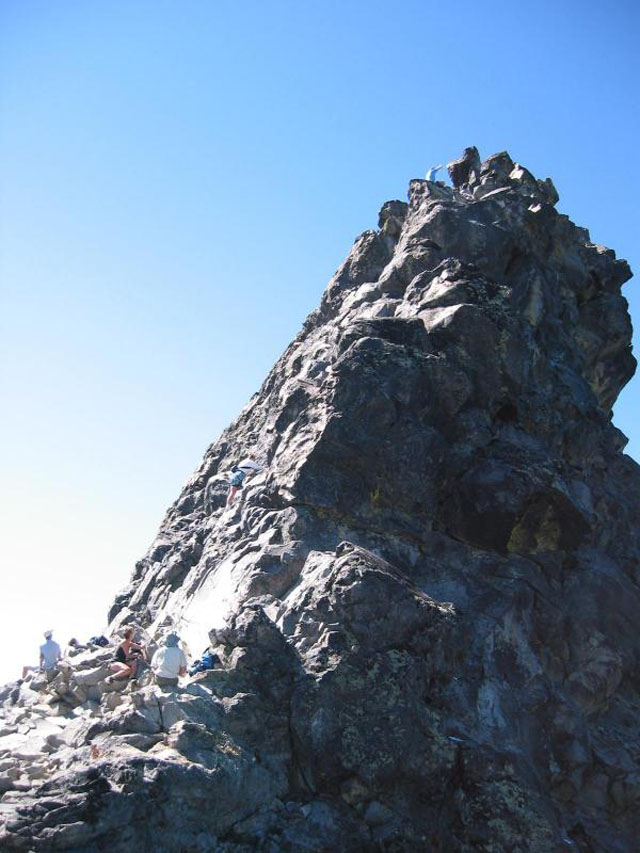 |
| Pictured: Deathiness. |
I had no rope, but the ascent was really just three or so sequences of 20-25 feet each, each time with a handy pile of deep snow right beneath me in case I fell. I left my other gear at the bottom of the block so I wouldn't fall and impale myself on any of it, and just set about digging in with my crampon "toes" and ice ax and working my way up the ice.
 |
| It's hard to see the scale, but this was basically what the block looked like. That rock sticking out on the left was a huge boulder the size of a few people. |
 |
| The Diamond Lake area and the Sisters, from the summit. |
 |
| Frozen pines during the descent. |
Subscribe to:
Posts (Atom)